

Your 401(k) Portfolio: One Job, One Fund, and Where the Rest Belongs
A little of everything is not a portfolio. Here is the 401(k) allocation by stage, and what belongs elsewhere.
19 min read

Key Takeaways
Search for what happens to your HSA after 65 and every result tells you the same thing first: the 20% penalty goes away. That is true, and it is the least useful true thing about turning 65.
Here is what actually costs people money. Somewhere between your 65th birthday and the day you file for Social Security, there is a date you have to stop putting money into your HSA. Miss it and the IRS reaches back into contributions you already made, calls them excess, taxes them, and charges you 6% a year until you take them out.
The IRS gives you one set of rules. Medicare gives you another. Your money gets caught where those two systems collide.
I want you to leave this article with one date written on your calendar. A rule you understand but never schedule can still cost you money. Here is how to find that date, what changes at 65, and how to decide each year whether to spend your HSA or leave it invested.
Three things change, and only three.
The penalty ends. Before 65, pulling money out of your HSA for something other than a qualified medical expense costs you ordinary income tax plus a 20% penalty. At 65 the penalty is gone. The income tax is not. Take $10,000 out for a new roof at a 22% federal rate and you owe roughly $2,200 in federal tax, the same as if the money had come from a traditional IRA. That is the honest answer to what tax rate applies to an HSA withdrawal after 65: your ordinary rate, whatever that turns out to be in the year you take it.
Your HSA can start paying Medicare premiums. Before 65, health insurance premiums are generally not a qualified expense. After 65, most Medicare premiums are, which turns a large recurring retirement bill into a tax-free one. There is one exception, and it is the exception the brochures bury. More on that below.
Medicare closes the door on contributions. The month your Medicare coverage begins, your eligibility to contribute ends. Eligibility is measured month by month, so a mid-year start prorates that year’s limit down to the months you were still eligible: turn on Medicare July 1 and you were eligible for six of twelve months, so half the annual limit is all you were entitled to put in. This is the change that arms the landmine, because Medicare enrollment is not always something you consciously choose.
The parts worth protecting stay exactly as they were.
Qualified medical expenses come out tax-free at any age, forever. There is no deadline on reimbursing yourself for an expense you paid out of pocket, as long as the expense happened after you opened the account and you never claimed it another way. If you have been banking receipts the way How To Invest HSA Funds lays out, that pile is still good at 70, 80, and 90.
There are no required minimum distributions on an HSA, so it can keep compounding while other accounts are being drained on someone else’s schedule.
And the money stays invested. Turning 65 does not require you to sell anything or move to cash.
This is why your HSA is still my top investment account after 65. Your 401(k) and traditional IRA eventually force money out. Your HSA lets you choose the timing, keeps the medical exit tax-free, and stays invested until you need it. The name says health account. The tax code gives you something much more valuable.
One thing that catches people: your HSA works like a traditional IRA after 65, but it never becomes one. You cannot roll it into your IRA or combine the two, and the IRS has no provision for moving money that direction at all. Traffic runs the other way only. Try it anyway and it is not a rollover, it is a withdrawal: the whole amount lands on your tax return that year, and those dollars lose the tax-free medical treatment for good. Keep the HSA open as its own account for life. That is where the tax-free medical lane lives, and it is the only place your banked receipts can be paid from.
| At 65 | What it means for your money |
|---|---|
| 20% penalty ends | Non-medical withdrawals are taxed like a traditional IRA withdrawal |
| Medicare premiums become qualified | A recurring retirement bill turns tax-free |
| Medicare enrollment ends contributions | Your contribution window has a closing date you control |
| Medical withdrawals still tax-free | Unchanged, for life |
| Old receipts still reimbursable | Unchanged, no deadline |
| No required distributions | The account compounds as long as you leave it alone |
Here is the sequence that catches people. I want you to see this one coming, so your HSA does not go boom.
If you delay Medicare past 65 and enroll later, Part A coverage is backdated up to six months, though never earlier than the month you turned 65. You did not ask for the retroactive coverage. It arrives with the enrollment.
Claiming Social Security does the same thing without an enrollment form, because filing for benefits at or after 65 enrolls you in Part A automatically. Same six-month backdate.
Now put those together with the contribution rule. Your HSA eligibility is measured month by month, and any month your Medicare coverage is in force is a month you were not eligible. So the backdate does not just stop your contributions going forward. It reaches back and disqualifies contributions you already made, in good faith, on a payroll schedule you set up months earlier.
Those become excess contributions. You owe income tax on them, and a 6% excise charge for every year they sit in the account.
Take someone who is 66, still working, still on their employer’s high-deductible plan, contributing at the family rate with the catch-up: $8,750 plus $1,000, which is $9,750 a year, or $812.50 a month.
They decide to retire and claim Social Security starting September 1, 2027.
Social Security enrolls them in Part A, backdated six months, to March 1, 2027.
March through August is six months of contributions that should never have happened:
$812.50 × 6 = $4,875 of excess contributions
That $4,875 is added back to income, and the excise charge is 6% of it, or $292.50, for each year it stays in the account. Their last safe contribution month was February 2027.
Change the numbers to yours and the arithmetic is the same. Your monthly contribution times the number of months inside the backdate window.
Stop contributing six months before the month you plan to claim Social Security or enroll in Medicare.
That is the whole defense. It costs you a few months of contributions you were entitled to make, and it saves you a spring spent unwinding a year of payroll deductions with your tax preparer.
| You claim in | Part A backdates to | Last safe contribution month |
|---|---|---|
| January | July of the prior year | June of the prior year |
| April | October of the prior year | September of the prior year |
| September | March | February |
| December | June | May |
If you already contributed inside the window, this is fixable, and the fix has a deadline. Pull the excess out, along with any earnings it generated, before your tax filing deadline including extensions, and the 6% charge does not apply. Your HSA provider has a form for it, and it is worth an hour with your tax preparer rather than a guess.
Every one of those rules is in IRS Publication 969, and the enrollment timing is on the Social Security side. Neither document tells you to count backwards from your claim date, because neither document is trying to plan your year.
Plenty of people reading this are nowhere near retiring, and most articles about HSAs after 65 quietly assume you are. Don’t worry, you are not a footnote here.
If you are 65 or older and still covered by your employer’s high-deductible health plan, you can keep contributing, at the full limit plus the catch-up, for as long as that stays true and you have not enrolled in any part of Medicare. Age does not end your HSA. Medicare does.
What that requires:
Spending and investing your HSA continue no matter which of these applies. Only new contributions are affected.
If you are still contributing, where those dollars belong is its own question. The HSA vs 401(k) Calculator puts the same paycheck dollars into your HSA, 401(k), Roth IRA, or brokerage and shows which one reaches the same spendable amount first, in years and months.
Once you are 65, your HSA can pay most Medicare premiums tax-free, which is the biggest new job the account picks up in retirement.
| Premium | Tax-free from your HSA? |
|---|---|
| Part B (medical) | Yes |
| Part D (prescription drug) | Yes |
| Part C (Medicare Advantage) | Yes |
| Medigap, also called Medicare Supplement | No |
| Employer-sponsored retiree health coverage | Yes |
| Qualified long-term care insurance | Yes, up to an age-based annual limit |
Medigap is the one IRS Publication 969 names and excludes, and it is the one people assume is covered because it sits next to the others on the same comparison page. Pay a Medigap premium from your HSA at any age and it is a non-qualified withdrawal.
There is a second benefit hiding in this table. A tax-free HSA withdrawal is not income, so it does not push you toward the next IRMAA bracket the way an IRA withdrawal does. IRMAA is the surcharge Medicare adds to your Part B and Part D premiums once your income crosses a threshold, and the thresholds are cliffs: one dollar over and the whole year costs more. Paying a year of Part B premiums from your HSA instead of from an IRA can be the difference between two Medicare premium tiers, and that is a decision you make one year at a time.
After 65 your HSA is really two accounts sharing one balance. There is a traditional-IRA bucket, taxed at your ordinary rate for anything non-medical. And there is a tax-free lane running alongside it for medical costs and most Medicare premiums.
Which one you draw from, and in what order relative to your other accounts, is where the money is. That order moves every year, with your income, your bracket, whether you are doing Roth conversions, whether required distributions have started (73 or 75, depending on your birth year), and where the IRMAA thresholds sit.
You can’t just set it and forget it. You have a twelve month time horizon, because Congress is constantly changing IRS rules, and a withdrawal order that was right in 2026 can be wrong in 2028 without you touching a thing.
Two things are stable enough to plan around, and they cut against each other:
The case for holding it. No required distributions, tax-free growth, and a medical lane that gets more valuable as healthcare costs rise. Left alone, it is the last account you touch.
Why I would not hold every dollar forever. Your HSA is a terrible account to leave to anyone other than your spouse. Leave it to a child and the tax shelter disappears the day you die. The full balance becomes taxable income to them in one year, with no stretch and no step-up. A nearly perfect tax account for you can become a one-year tax pileup for them. Deliberately drawing it down during your own low-tax years can be better than preserving it forever.
That is the trade-off, and it lands differently for a single filer at 66 with a large IRA than for a married couple at 70 living mostly on Social Security. The published rules are the same for both. The answer is not.
This is the reason the Withdrawal Waterfall Calculator exists in Gold+ instead of a static ranking of accounts. It builds an estimated current-year withdrawal sequence against this year’s brackets and thresholds, shows where a Roth conversion may fit, and flags the numbers worth confirming before you move money. You re-run it next year, because next year is a different question. Getting that sequence wrong once can cost more than years of membership, which is why it sits alongside the portfolios and the risk work instead of standing on its own.
If you are not a member, the rest of this article still gets you there. Set the stop date, use the premium table, and run the spend-or-hold trade-off with your own bracket in front of you.
One line on your account form decides this, and most people have never looked at it.
Check the beneficiary designation on your HSA the same way you would on a 401(k). Custodians change, employers change, and that field is easy to leave blank.
If you are earlier in this than 65, the setup work is in How To Invest HSA Funds, the contribution order against your other accounts is in HSA vs Roth IRA, and the open enrollment decision that gets you an HSA in the first place is in HSA vs FSA. Where the HSA sits among everything else you will live on is in Retirement Income Sources.
Yes, as long as you are covered by a qualifying high-deductible health plan and have not enrolled in any part of Medicare. Age by itself does not end your eligibility. Medicare enrollment does, and claiming Social Security triggers Medicare Part A automatically.
Withdrawals for qualified medical expenses are tax-free at any age. Withdrawals for anything else are taxed as ordinary income at your regular rate, the same as a traditional IRA withdrawal. The 20% penalty that applies before 65 no longer applies.
Six months before the month you plan to claim Social Security or enroll in Medicare. Part A can be backdated up to six months, and any contribution made inside that retroactive window becomes an excess contribution subject to income tax and a 6% excise charge for each year it remains.
Yes for Part B, Part D, and Part C, and yes for employer-sponsored retiree health coverage. No for Medigap, also called Medicare Supplement, which the IRS specifically excludes.
A spouse named as beneficiary inherits it as their own HSA with no tax. Any other beneficiary receives the full value as taxable income in the year of death, reduced by qualified medical expenses you incurred before death and paid within one year.
$4,400 with self-only coverage and $8,750 with family coverage, plus a $1,000 catch-up contribution once you are 55 or older. If your eligibility ends partway through the year, the limit is prorated by the months you were eligible.
A little of everything is not a portfolio. Here is the 401(k) allocation by stage, and what belongs elsewhere.
19 min read
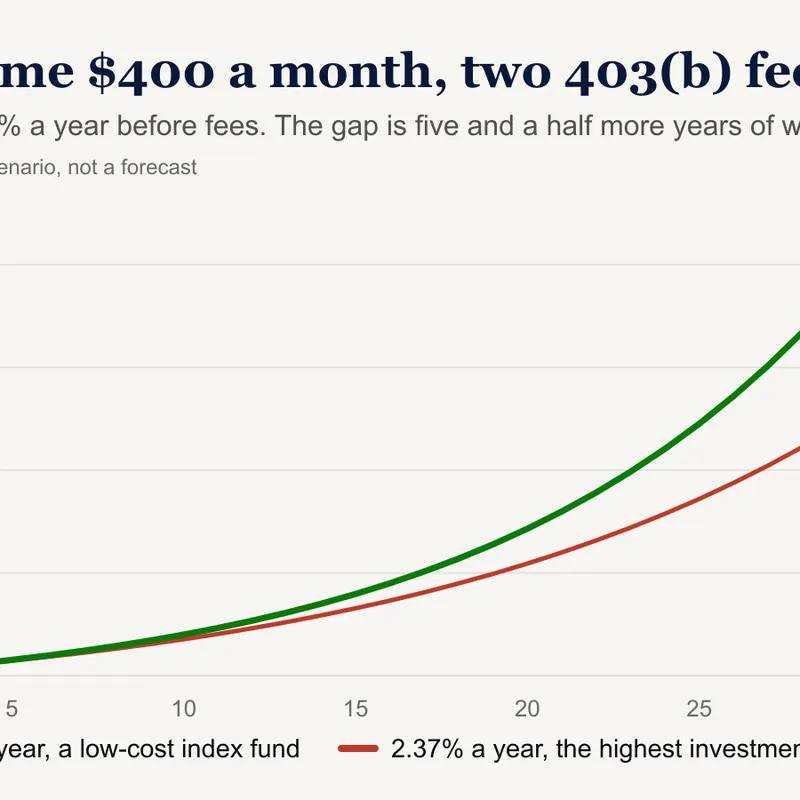
I used to sell 403(b) annuities to teachers, but not anymore. What I learned to do and what NOT to do could save you years off your retirement date.
20 min read

Target-date fund vs S&P 500, run on real returns. One of them took 4.5 to 5.6 years longer to get you to the same number.
13 min read