

Your 401(k) Portfolio: One Job, One Fund, and Where the Rest Belongs
A little of everything is not a portfolio. Here is the 401(k) allocation by stage, and what belongs elsewhere.
19 min read
Key Takeaways
I lasted eighteen months selling 403(b) annuities to teachers. I just felt dirty. I literally woke up Monday mornings disgusted to go to work, and I had to leave.
If you are more than 10 years from retirement, put your 403(b) in a low-cost S&P 500 index fund, or the closest thing to one your plan offers. Inside 10 years, 70% stays there and 30% moves to a stable value fund.
| Years to retirement | The job | What to hold |
|---|---|---|
| More than 10 | Build wealth | 100% S&P 500 index fund |
| Less than 10 | Protect what you built | 70% S&P 500 index fund, 30% stable value fund |
That is the same answer I give anyone with a 401(k), and I have already made the full case for it twice: once on why a target-date fund costs you years, and once on how to structure the whole account. Nothing about the reasoning changes because your employer is a school district instead of a corporation. What changes is your specific menu, and what is on it.
I know that menu from the other side of the table. My first job after business school was as a financial advisor at an insurance company, selling 403(b) annuities to teachers. The fees inside those contracts ran around 4% a year at the time.
What I saw in every one of those meetings is still true. When a teacher or a nurse opens up their 403(b), they know they should be saving for retirement. They just don’t understand where to start.
A 403(b) is a retirement account your employer sets up for you, and only certain employers can. Public schools, universities, hospitals, churches and other charities with tax-exempt status. If you work for one of those, this is your version of a 401(k).
The IRS still calls it a tax-sheltered annuity plan, which tells you where it came from. For decades the only thing a 403(b) could hold was an annuity contract from an insurance company. The law now allows mutual funds too, and that history is the reason your menu looks the way it does. I will come back to that.
How the money goes in. You choose a percentage of each paycheck and it goes in before income tax, so your taxable pay drops by that amount. Many plans also offer a Roth version, where the money goes in after tax and comes out tax-free. The 2026 limit on your own contributions is $24,500. From age 50 you can add another $8,000, and between 60 and 63 that catch-up rises to $11,250 instead. Those are the same numbers as a 401(k). Some employers match part of what you put in. Check whether yours does, because the answer changes what I recommend below.
How the money comes out. It grows with no tax bill along the way. Before 59½, the taxable part of a withdrawal generally faces income tax and a 10% additional tax unless an exception applies. One exception matters for a lot of teachers: leave your job in or after the year you turn 55 and you can take money from that employer’s 403(b) with no penalty. Traditional 403(b) money generally requires withdrawals at 73 or retirement, whichever comes later. Roth 403(b) money has no lifetime required withdrawals.
How it compares to a 401(k). Same limits, same tax treatment, same penalty rules. The difference is who offers it and what it is allowed to hold. A few employers offer both, and choosing between them is its own question for another day.
Two facts about the law explain almost every 403(b) I have ever seen.
The law limits what a 403(b) can hold. For most school and nonprofit employees, a 403(b) holds annuity contracts or mutual funds. Church retirement accounts can have broader choices. No individual stocks, no exchange-traded funds. That is a narrower list than most 401(k) plans have, and it means an insurance company can be the whole menu.
Most public school plans are not covered by the federal law that protects a 401(k). That law is ERISA, and it requires the people running a private-sector plan to act in your interest when they choose the investments. That federal protection does not generally cover public-school or church plans, although state law or the plan’s own rules may still protect you. In a 2022 survey by the Government Accountability Office, five public school district plan sponsors said they did not know the expense ratios of the funds in their own plan.
Put those two facts together and you get the options most teachers see: one insurance company, one annuity, and a salesperson. It is not like there is a Fidelity option and an annuity option side by side. Most teachers just have one option. In the same survey, GAO found that university plans, state-sponsored plans and plans holding $1 billion or more had taken steps to cut fees, and that large plans paid lower administrative fees than small ones. The question you ask is the same everywhere.
Ask this, in these words: How much do I have to pay just to be in this plan?
Not “what is the fee on this fund.” You may get an honest answer to that, and it will be the small number. Ask about the plan itself. The administration fee, the contract fee, the mortality and expense charge, whatever they call it. Say no, no, no, just the overall plan maintenance fees. How much do I have to pay just to be in this plan?
They are never going to come out and tell you it is 4%. In my experience nobody volunteers that number. But they have to answer a direct question, and the answer determines what you do next.
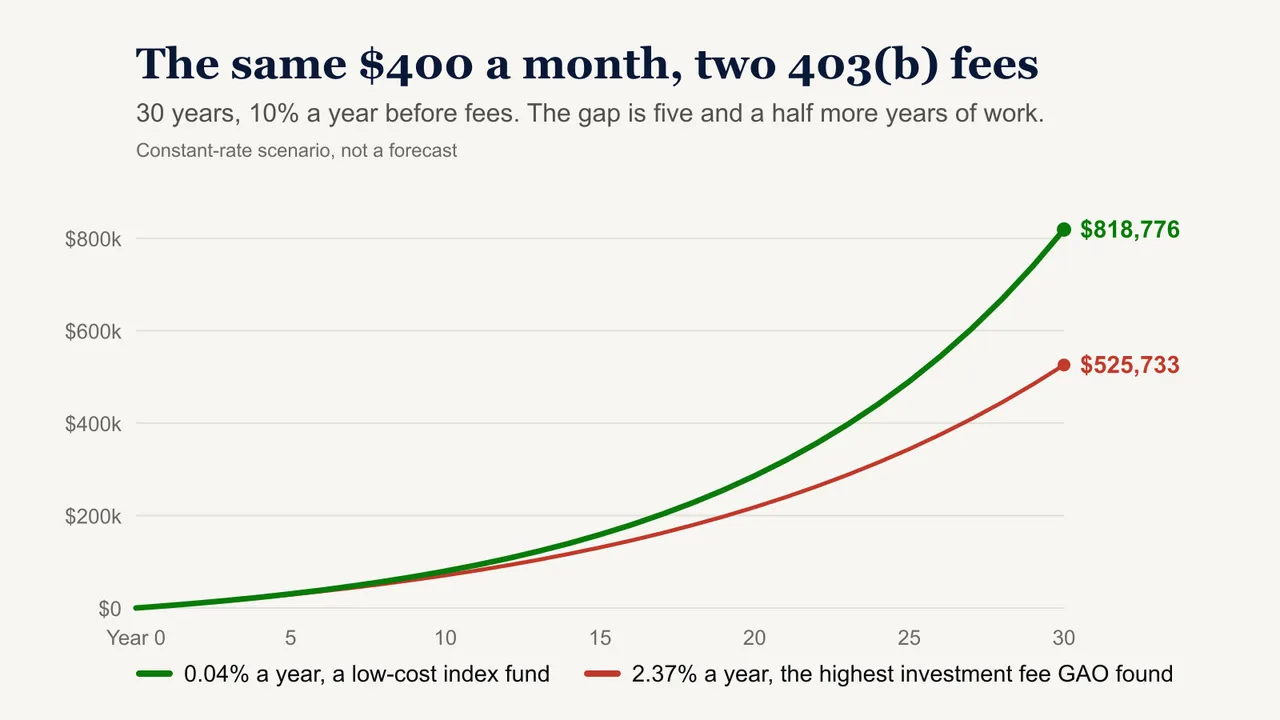
In that same 2022 study, the Government Accountability Office found 403(b) investment fees running from 0.01% to 2.37% a year, and plan administration fees from almost nothing to 2.01% of your balance every year. A low-cost S&P 500 index fund costs about 0.04%. The gap between the bottom of that range and the top is the difference between two very different retirements.
Say you put $400 a month into your 403(b) for 30 years and the market returns 10% a year before fees.
| Annual investment fee used in this example | Balance after 30 years | Years to reach $819,000 |
|---|---|---|
| 0.04% | $818,776 | 30.0 |
| 2.37% | $525,733 | 35.5 |
Same paycheck. Same contribution. Same market. The high-fee version costs you $293,043, which is five and a half more years of work to end up in the same place. That is a constant-rate scenario, not a forecast, and it is the same test I ran on target-date funds in a 401(k). You may not control what the plan charges. You control what you do once you know.
The job of your 403(b) while you are working is growth. Go down my list and allocate to the first option your plan has:
Your allocation. If you are within 10 years of retirement, 30% of the account moves to a stable value fund. In a 403(b) that may be called a fixed account or a guaranteed interest account. Take the one with the highest credited rate and no surrender charge. If the plan has none, use a short-term bond fund. Do not use a broad bond index fund; I wrote about why after 2022, when stocks and bonds fell together.
You will have to change two settings, not one. Most plans keep the money already in the account separate from where future paychecks go. Change both, or the balance you already have sits exactly where it was. The mechanics are the same as a 401(k), and I walked through the screens here.
If your plan offers a choice, do not go with the annuity. Go with the straight 403(b) mutual fund option and pick the S&P 500 index fund from it.
If you are already in one, you’re stuck, and there’s no good way to say this. This has gotten better over the years, and I hope fewer teachers get put in these than when I was selling them, but it still happens, especially in smaller school districts.
Two things decide what you can do.
Read your surrender schedule. An annuity charges you to leave for a set number of years. GAO found surrender charges as high as 10% and surrender periods as long as 15 years, with the charge dropping a point or two a year until it hits zero. Some contracts run that clock from the day you opened the account. Others run a separate clock on every contribution you make, so the money you put in last month has its own eight-year wait. Call the insurance company and ask which one you have, and ask for the schedule in writing.
Then do the allocation anyway. Inside that annuity there is still a menu of funds, and the choice is still the S&P 500 index fund, or the closest thing to it. Use the allocation above while you weigh the cost of leaving. Until you are past the surrender charge, it is the only lever you have. The one thing not to do is hold a little bit of everything because the salesperson suggested it. When I was selling these, the fund companies paid us more to put people in their funds. A scattered account was good for us and bad for you.
Once you are past the surrender period, you can move the money out. While you still work there, that usually means exchanging into a lower-cost company on your district’s approved vendor list, if it has one. Once you leave, you can make a direct rollover of the whole balance into a Rollover IRA and never look at that contract again. Some plans also allow a rollover at 59½ while you are still employed; reaching that age does not guarantee it, so ask yours.
Take the match, and then look at the whole household. If your employer matches part of your contribution, contribute enough to get all of it, annuity or not. It’s part of your salary. But if there is no match and the plan is expensive, and you have a partner with a good 401(k), or an IRA, or an HSA, put the next dollar there instead. You are saving for one retirement as a family, so fund the cheapest accounts first and let the expensive one wait. This calculator works out that order for you.
That depends on four numbers: your planned spending, pension, Social Security, and what you have already saved.
Your pension, your Social Security, your investable portfolio. It’s just the difference in those things that you need to live off of. If your pension and Social Security will cover everything you plan to spend, you do not need to contribute at all. If they cover part of it, the gap is what your 403(b) has to fill, and the size of that gap is the whole answer. Run your number here. It takes your pension and Social Security off the top and tells you what your own money has to cover.
Whatever that number says, the thing I want you to remember is that you need to start. And then do one more thing every year.
Put half of every raise into your 403(b). I came up with this rule with clients many years ago, and it is the simplest one I know. When you get a raise, you increase your standard of living a little bit, and you also increase your standard of saving. Spend the whole raise and your savings rate falls every single year, because your spending went up and your saving did not. Save half of it and your savings rate rises every single year.
Say you earn $60,000 and save 8% of it, which is $4,800. You get a $3,000 raise.
| What you do with the raise | You now save | Savings rate |
|---|---|---|
| Spend all of it | $4,800 | 7.6% |
| Save half of it | $6,300 | 10.0% |
You still got a $1,500 raise in take-home pay. Your future self got the other $1,500, every year, forever. Do that ten times over a career and you have never once felt a cut.
A 403(b) can do one thing a 401(k) cannot. If you have worked 15 years or more for the same public school system, hospital, home health service agency, health and welfare service agency, or church, you may be allowed to contribute up to $3,000 a year above the normal limit, capped at $15,000 over your lifetime.
The rule has a third condition, and it is the reason the rule exists. Each year, the extra amount is the lowest of three numbers:
That third line means the catch-up is for people who under-saved early and want to make it up. If you have 16 years in and put in $48,000 over those years, the third line is $80,000 minus $48,000, which is $32,000. You qualify for the full $3,000. If you have maxed out your 403(b) every year, the third line goes negative and you get nothing extra. The law is written for the teacher who could not afford to save in her twenties, which is most of them.
If you qualify for both this and the age-50 catch-up, the law fills the 15-year one first. Ask your plan administrator whether the plan offers it, because not every plan does, and ask them to run the calculation.
Teachers move districts. Nurses move hospitals. A direct rollover to a low-cost IRA is often the cleanest move. Check two things first. A direct rollover keeps the transfer untaxed, the money stays inside a retirement account, and the IRA can hold anything. The handcuffs come off.
First, the surrender schedule, if your 403(b) is an annuity. Leaving your job does not cancel it. If you are two years from the end of an eight-year schedule, it can be worth leaving the money where it is until the charge hits zero.
Second, the age-55 rule. If you left that job in or after the year you turned 55, you can take money out of that 403(b) with no early-withdrawal penalty. Roll it to an IRA and that goes away; you are back to waiting until 59 and a half. If you are in that window and need the money before 59 and a half, leave enough in the 403(b) to cover it.
The same decision for a 401(k), with the same trade-offs, is answered here.
Then go do something fun. Your 403(b) has a job now.
Nobody is watching your 403(b), least of all the insurance company that sold it.
Gold+ connects your plan, portfolio, and protection in one system. See whether you’re behind, on track, or ahead, follow the Refined FI portfolio built for your stage, and get an email when market risk calls for a change.
Prefer to see it first? Watch the 2-minute look inside Gold+.
A 403(b) is a workplace retirement account for employees of public schools, universities, hospitals, churches and other tax-exempt organizations. You choose a percentage of each paycheck to contribute, it goes in before tax (or after tax in the Roth version), and it grows with no tax bill until you withdraw it in retirement. It does the same job as a 401(k) with the same contribution limits.
A 403(b) with a low-cost S&P 500 index fund and a small plan fee is an excellent place to build wealth. A 403(b) that is one high-fee annuity is still worth using for any employer match, and beyond that your next dollar may do better in a partner’s plan, an IRA or an HSA.
They have the same contribution limits, tax treatment and withdrawal rules. A 401(k) usually has a wider menu, because a 403(b) is limited by law to annuities and mutual funds. A 403(b) has one advantage: the 15-year catch-up, worth up to $3,000 a year for long-serving employees of a qualifying employer.
The menu can be limited to one insurance company’s annuity, many public school plans have no legal requirement that anyone act in your interest when choosing that menu, and the fees can run above 2% a year with surrender charges lasting as long as 15 years. Every one of those is a fee problem, and the fix is to ask what the plan costs and hold the lowest-cost stock index fund on the menu.
$24,500 of your own money. From age 50 you can add $8,000 more, and between ages 60 and 63 the catch-up is $11,250 instead. Employees with 15 years of service at a qualifying employer may add up to $3,000 more a year, up to $15,000 in a lifetime.
The money is yours and stays invested. You can leave it in the plan, make a direct rollover into a Rollover IRA with no tax owed, or roll it into a new employer’s plan. Check the surrender schedule first if it is an annuity, and remember that rolling to an IRA gives up the penalty-free withdrawals you get from a 403(b) after leaving a job in or after the year you turn 55.
If they are high fee, NO! I sold them for eighteen months and left because of what they cost the teachers who bought them. If your plan offers mutual funds, choose those. If you are already in an annuity, pick the S&P 500 index fund inside it, find out your surrender schedule, and move the money out once the charge reaches zero.
Without penalty from age 59½, or from the year you turn 55 if you have left that employer. Before 59½, the taxable part of a withdrawal generally faces income tax and a 10% additional tax unless an exception applies, such as disability or certain medical expenses. Traditional 403(b) money generally requires withdrawals at 73 or retirement, whichever comes later. Roth 403(b) money has no lifetime required withdrawals.
This article is for educational and informational purposes only and does not constitute investment, financial, tax, or legal advice. Refined FI is not a registered investment advisor. Past performance does not guarantee future results. All investing involves risk, including possible loss of principal. Contribution limits and the 15-year catch-up rule are from the IRS for 2026. Fee ranges and surrender schedules are from the Government Accountability Office report GAO-22-104439, March 2022. The 30-year comparison extends a 10% gross annual return as a constant-rate scenario and is not a forecast; the index fund cost of 0.04% is the Vanguard 500 Index Fund Admiral Shares expense ratio. Plan rules vary; confirm yours with your plan administrator. Refined FI receives $0 in compensation from any fund company, insurer or plan mentioned.
A little of everything is not a portfolio. Here is the 401(k) allocation by stage, and what belongs elsewhere.
19 min read
I used to sell 403(b) annuities to teachers, but not anymore. What I learned to do and what NOT to do could save you years off your retirement date.
20 min read

Target-date fund vs S&P 500, run on real returns. One of them took 4.5 to 5.6 years longer to get you to the same number.
13 min read