

Your 401(k) Portfolio: One Job, One Fund, and Where the Rest Belongs
A little of everything is not a portfolio. Here is the 401(k) allocation by stage, and what belongs elsewhere.
19 min read

Key Takeaways
That is how much longer the three target-date funds I tested required to reach $1 million compared with the S&P 500. Same starting balance. Same monthly contribution. Different investments.
Compared with the S&P 500, target-date funds add bonds, international stocks, emerging markets, small caps, and other assets your 401(k) does not need for its main job: compounding.
The best 401(k) investment for most investors more than 10 years from retirement is a low-cost S&P 500 index fund. Here is what choosing a target-date fund instead could cost you.
I compared the S&P 500 with three large 2040 target-date funds using their common performance period from March 1, 2018 through July 10, 2026.
The scenario starts at $0, adds $833.33 at the end of every month, and measures how long each investment would take to reach $1 million if its annualized historical return continued.
| Investment | Annualized return | Years to $1 million | Additional years |
|---|---|---|---|
| S&P 500 / SPY | 14.99% | 19.42 | — |
| Fidelity FFIZX | 10.60% | 23.92 | 4.50 |
| BlackRock LIKKX | 9.92% | 24.92 | 5.50 |
| Vanguard VFORX | 9.86% | 25.00 | 5.58 |
Five additional years of work is not a rounding error. It is five more years of commutes, meetings, deadlines, and asking permission to take a vacation.
The chart below shows where the gap came from. Over the same period, SPY returned 221.5%. The target-date funds returned between 119.4% and 132.1%.
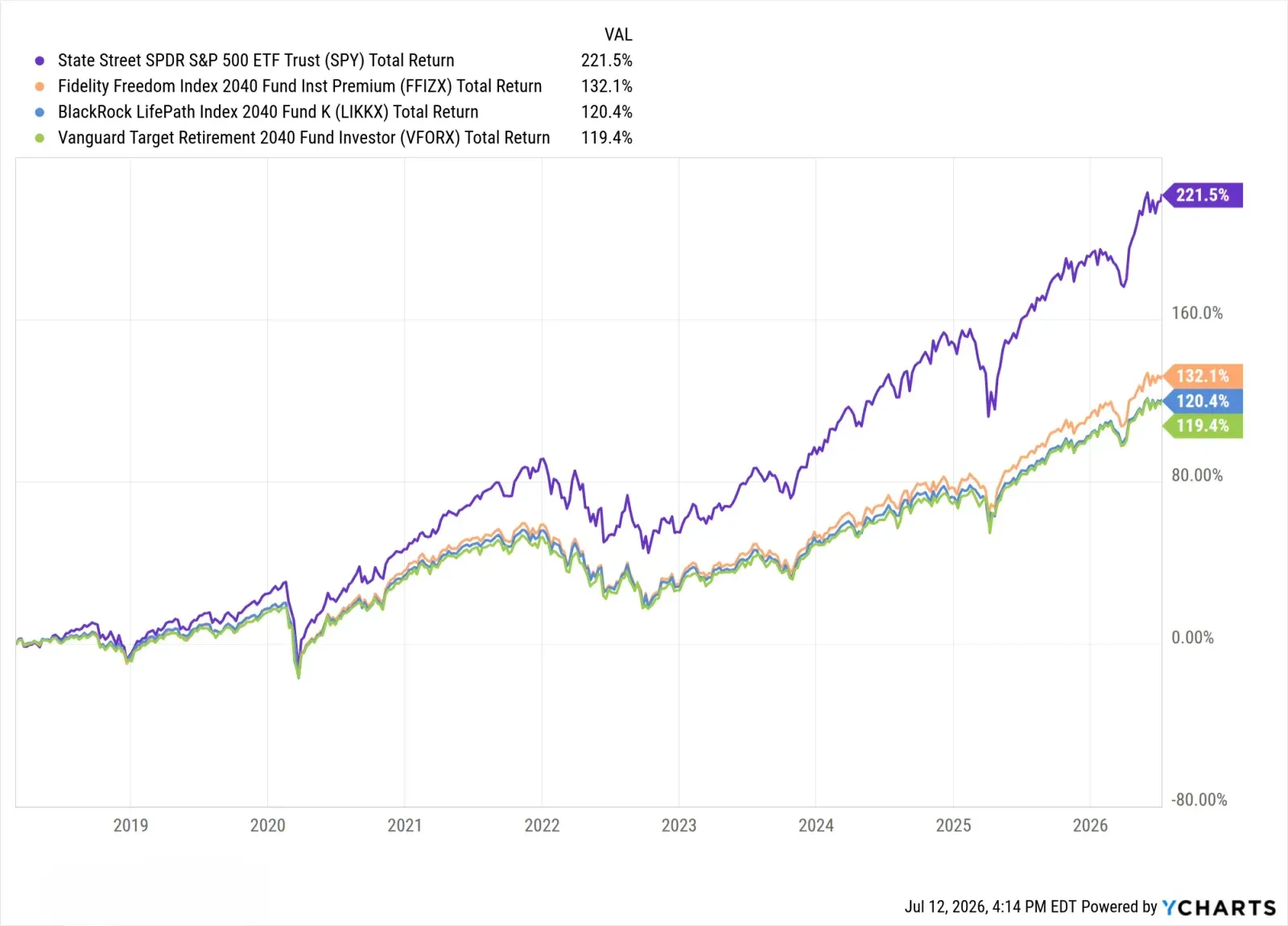
This is a historical-rate scenario, not a forecast. Future returns will differ. The comparison shows what the return gap meant in practical terms: same contributions, same $1 million destination, and a much longer trip.
Target-date funds are supposed to reduce risk. The question is how much protection you received for the annual return you surrendered.
| Investment | Annualized return | Maximum drawdown | Annual return given up | Maximum drawdown improvement |
|---|---|---|---|---|
| S&P 500 / SPY | 14.99% | −33.70% | — | — |
| Fidelity FFIZX | 10.60% | −30.69% | 4.39% per year | 3.01% |
| BlackRock LIKKX | 9.92% | −31.13% | 5.07% per year | 2.57% |
| Vanguard VFORX | 9.86% | −29.35% | 5.13% per year | 4.35% |
The target-date funds gave up 4.4 to 5.1 percentage points of return every year. In exchange, they improved the maximum drawdown by only 2.6 to 4.4 percentage points.
You paid for diversification with five years of your life. The protection you received was made up in less than one year of S&P returns.
Target-date funds look like one investment. Inside, they are collections of other funds.
In the three examples, only $41 to $48 of every $100 went into the main U.S. stock engine. The remaining $52 to $59 went somewhere else.
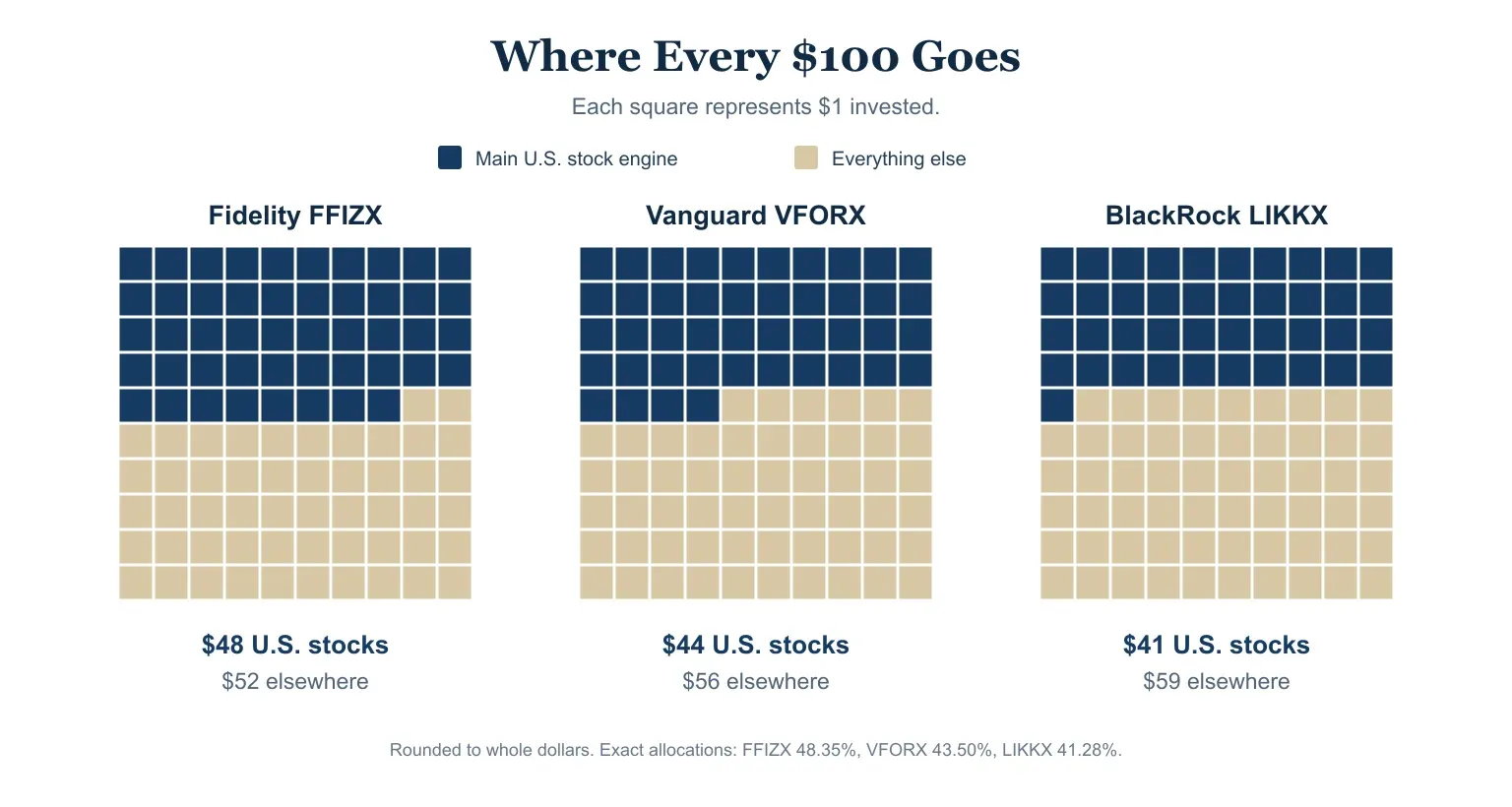
Main U.S. stock engine excludes LIKKX’s separate 1.81% Russell 2000 small-cap holding.
Here is where the rest went:
| Fund | U.S. stocks | International stocks | U.S. bonds | International bonds | Real estate/infrastructure | Cash/other |
|---|---|---|---|---|---|---|
| FFIZX | 48.35% | 32.10% | 16.57% | 2.93% | — | 0.05% |
| LIKKX | 43.09% | 26.84% | 24.76% | — | 5.12% | 0.20% |
| VFORX | 43.50% | 30.20% | 18.10% | 7.60% | — | 0.60% |
These funds added extra assets. But that extra bulk just cost you time and freedom.
For investors more than 10 years from retirement, that account’s job is building wealth. Every dollar redirected into bonds, international markets, emerging markets, small caps, cash, and other holdings must justify why it deserves space instead of the S&P 500.
Imagine you are trying to lose weight.
You create a grocery list built around that goal. Then someone replaces it with a “complete meal plan” containing vegetables, lean protein, chips, ice cream, and several foods you never asked for.
The meal plan is diverse. It is convenient. It is also working against your goal.
Target-date funds do the same thing to your 401(k). They package U.S. stocks, international stocks, emerging markets, small caps, bonds, cash, and other assets into one “complete” retirement product. But your 401(k) does not need a complete meal plan. More than 10 years from retirement, it needs a growth engine.
Every unnecessary asset consumes part of each contribution and slows progress toward the goal. Then the fund adds more low-growth assets as retirement approaches, when your account balance is largest and each percentage point matters most.
Target-date funds solve the provider’s need for one scalable default product. Convenience for the provider becomes friction for the investor.
The fund knows your expected retirement year. It does not know your pension, Social Security benefit, other accounts, savings rate, income needs, or the job this 401(k) needs to perform.
The date in a fund’s name is not a financial plan.
Target-date funds are built around a simple assumption: owning more types of assets creates a better retirement portfolio.
That assumption ignores the purpose of the account. Your 401(k) does not need to own every asset class. It needs to perform its assigned role inside your complete retirement map.
Target-date fund companies call these additional holdings diversification. They own more asset classes, but owning more things is not the same as reducing risk.
True diversification comes from combining assets that behave differently. International stocks often fall alongside U.S. stocks, sometimes more so, because they depend on the same global growth engine.
I will cover true diversification, and why more holdings do not automatically create a better portfolio, in an upcoming article.
Bonds can reduce volatility and provide income. Those jobs matter near retirement.
More than 10 years from retirement, bonds slow the 401(k)‘s primary job: compounding. The three target-date funds already held roughly 20% to 25% in bonds, and their automatic adjustments will add more as 2040 approaches.
Bonds only diversify stocks when they behave differently. As of July 12, 2026, Refined FI’s 12-month SPY/AGG correlation was +34%, meaning stocks and broad bonds had recently moved in the same direction. That weakens the diversification benefit investors expect from adding bonds.
Broad bond funds also have structural problems. Their indexes give the largest weights to the biggest borrowers, not necessarily the strongest ones. I explain that problem in Does Your Bond Fund Need Ozempic?.
International exposure sounds like diversification. But S&P 500 companies already operate globally, earning substantial revenue outside the United States.
Target-date funds add another 27% to 32% in dedicated international stocks. That includes developed and emerging markets, whether those holdings are good investments or not.
More countries do not automatically create a better growth engine.
Small companies once offered a reliable return premium. Today, many small-cap indexes contain unprofitable companies kept alive by repeated borrowing and refinancing.
A total-market fund buys those companies automatically. The S&P 500 applies a profitability requirement before a company can enter the index.
I covered this structural drag in Dead Weight: Zombies in Your Portfolio.
Cash, real estate, and infrastructure can each serve legitimate purposes. But a legitimate asset is not automatically the right asset for your 401(k).
Cash belongs in emergency reserves. Real assets may belong elsewhere in the portfolio. Stability becomes more important as retirement approaches.
Putting every useful asset inside one fund does not make the fund optimized. It makes the fund convenient.
The common-period comparison was not an isolated result. The S&P 500 also outperformed all three target-date funds across every available 5-, 10-, and 15-year period.
| Fund | 15 years | 10 years | 5 years |
|---|---|---|---|
| SPY | 14.25% | 15.40% | 13.30% |
| Fidelity FFIZX | 9.72% | 11.51% | 8.86% |
| BlackRock LIKKX | 9.31% | 10.55% | 8.13% |
| Vanguard VFORX | 9.73% | 10.83% | 8.42% |
These periods contain different markets, so the table cannot isolate one cause for the performance gap. It does show that the drag was persistent, not limited to one fund or one timeframe.
Target-date funds do not merely start with structural drag. Their adjustments add more unneeded assets as the retirement date approaches, when the account balance is largest and each percentage point matters most.
The timing makes the damage worse. A one-percentage-point return gap matters more against a $700,000 balance than a $70,000 balance. Target-date funds add more low-growth assets at the stage when lost compounding costs the most dollars.
Your 401(k) has different funds
I tested three target-date funds against the S&P 500. Your plan offers different options, and you want to see how that impacts your retirement.
See what your allocation costs you →
Set your allocation. The answer comes back in years and months.
A 401(k)‘s job changes as retirement approaches.
More than 10 years away, the account should prioritize compounding. Within 10 years, protecting part of the balance from a major stock-market decline becomes more important.
| Time to retirement | Main job | 401(k) allocation |
|---|---|---|
| More than 10 years | Build wealth | 100% low-cost S&P 500 index fund |
| Less than 10 years | Prepare for withdrawals | 70% S&P 500 / 30% stable value fund |
I recommend a stable value fund (or a short-term bond fund if stable value is unavailable), not a broad bond index fund. Broad bonds may not reduce risk when stocks and bonds are correlated.
This is the simple 401(k) protocol. Your complete retirement plan may include other accounts, income sources, taxes, and withdrawal needs.
That table covers the one account. For how the whole 401(k) should be structured, and what belongs in your IRA and HSA instead, read Your 401(k) Portfolio.
For instructions on changing both your current balance and future contributions, read How to Invest Your 401(k).
Federal employees have the same problem in a different wrapper, because the TSP’s L Funds are target-date funds.
Log in to your 401(k).
Then:
Make sure every dollar in the account has the right job.
The complete 401(k) investment guide explains brokerage windows, bad plan menus, stable value funds, and exactly where to make each change. If your plan is a 403(b), start here instead.
If a retirement calculator already says you are behind, the fund inside your 401(k) is the first place to look, and it costs nothing to change: how to catch up on retirement savings.
What other decisions are delaying your retirement?
Gold+ connects your plan, portfolio, and protection in one system. See whether you’re behind, on track, or ahead, follow the Refined FI portfolio built for your stage, and get an email when market risk calls for a change.
Prefer to see it first? Watch the 2-minute look inside Gold+.
If you are more than 10 years from retirement, I recommend a low-cost S&P 500 index fund. Within 10 years, use the 70% S&P 500 / 30% stable value protocol.
Yes. If you are more than 10 years from retirement, exchange both your current target-date fund balance and future contributions into a low-cost S&P 500 index fund.
Target-date funds redirect large portions of each contribution into bonds, international stocks, emerging markets, small caps, cash, and other assets. Less money reaches the main U.S. growth engine.
Not by much in the comparison. During the common period, SPY’s maximum drawdown was 33.70%. The three target-date funds fell between 29.35% and 31.13%.
They reduced the worst decline by only 2.6 to 4.4 percentage points while taking 4.5 to 5.6 additional years to reach $1 million in this historical-rate scenario.
I recommend 70% in a low-cost S&P 500 index fund and 30% in a stable value fund. If stable value is unavailable, use a short-term bond fund, not a broad bond index fund.
This article is for educational and informational purposes only and does not constitute investment, financial, tax, or legal advice. Refined FI is not a registered investment advisor. Past performance does not guarantee future results. All investing involves risk, including possible loss of principal. Performance and drawdown figures were sourced from YCharts through July 2026. The $1 million comparison extends annualized historical returns as a constant-rate scenario; it is not a forecast. Fund holdings were sourced from Fidelity, BlackRock, and Vanguard materials dated May or March 2026. Holdings, allocations, expenses, and performance change over time. Refined FI receives $0 in compensation from any fund company mentioned.
A little of everything is not a portfolio. Here is the 401(k) allocation by stage, and what belongs elsewhere.
19 min read
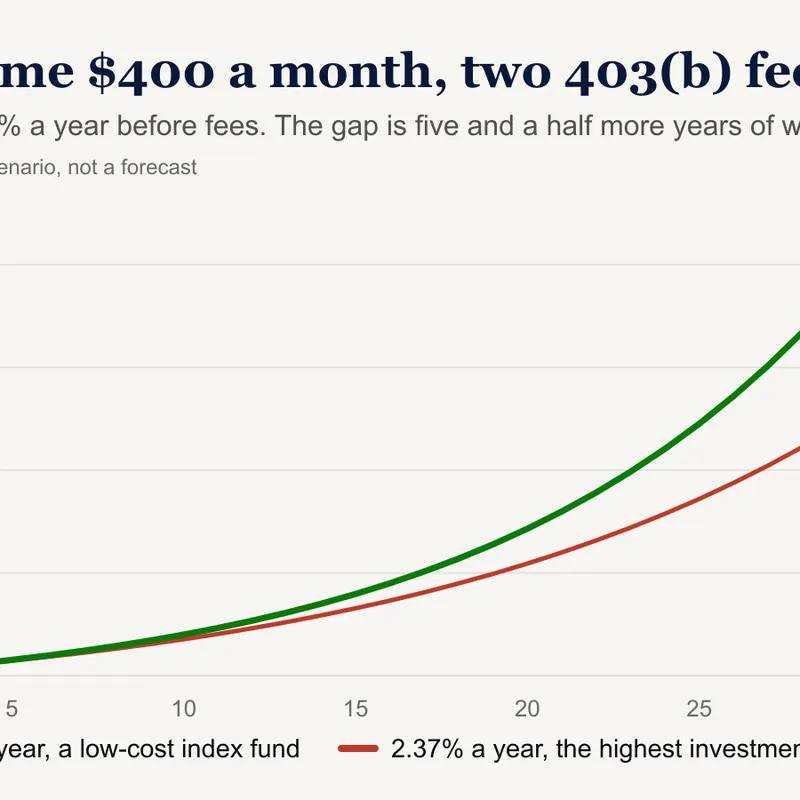
I used to sell 403(b) annuities to teachers, but not anymore. What I learned to do and what NOT to do could save you years off your retirement date.
20 min read

Target-date fund vs S&P 500, run on real returns. One of them took 4.5 to 5.6 years longer to get you to the same number.
13 min read