

Your 401(k) Portfolio: One Job, One Fund, and Where the Rest Belongs
A little of everything is not a portfolio. Here is the 401(k) allocation by stage, and what belongs elsewhere.
19 min read

Key Takeaways
You already have a 401(k) portfolio. You were defaulted into a target-date fund, or you picked a smattering of funds yourself because owning a little of everything felt safe.
A little of everything is not a portfolio. It’s obesity for your retirement.
Eat dinner at a Las Vegas buffet and choose one of everything and you will not go hungry. You will go slow. Over time, a little of everything in your portfolio means deeper losses, bigger swings, and lower returns. All three at once.
Here is what your account should hold instead.
Search for what your 401(k) should look like and the top result is a few hundred strangers arguing about it. One camp says target-date fund: set it and forget it. The other says put it all in the S&P 500 and thank them in forty years. Both camps are answering a question about funds. You asked a question about structure.
So start with the structure. The order of operations runs in one direction:
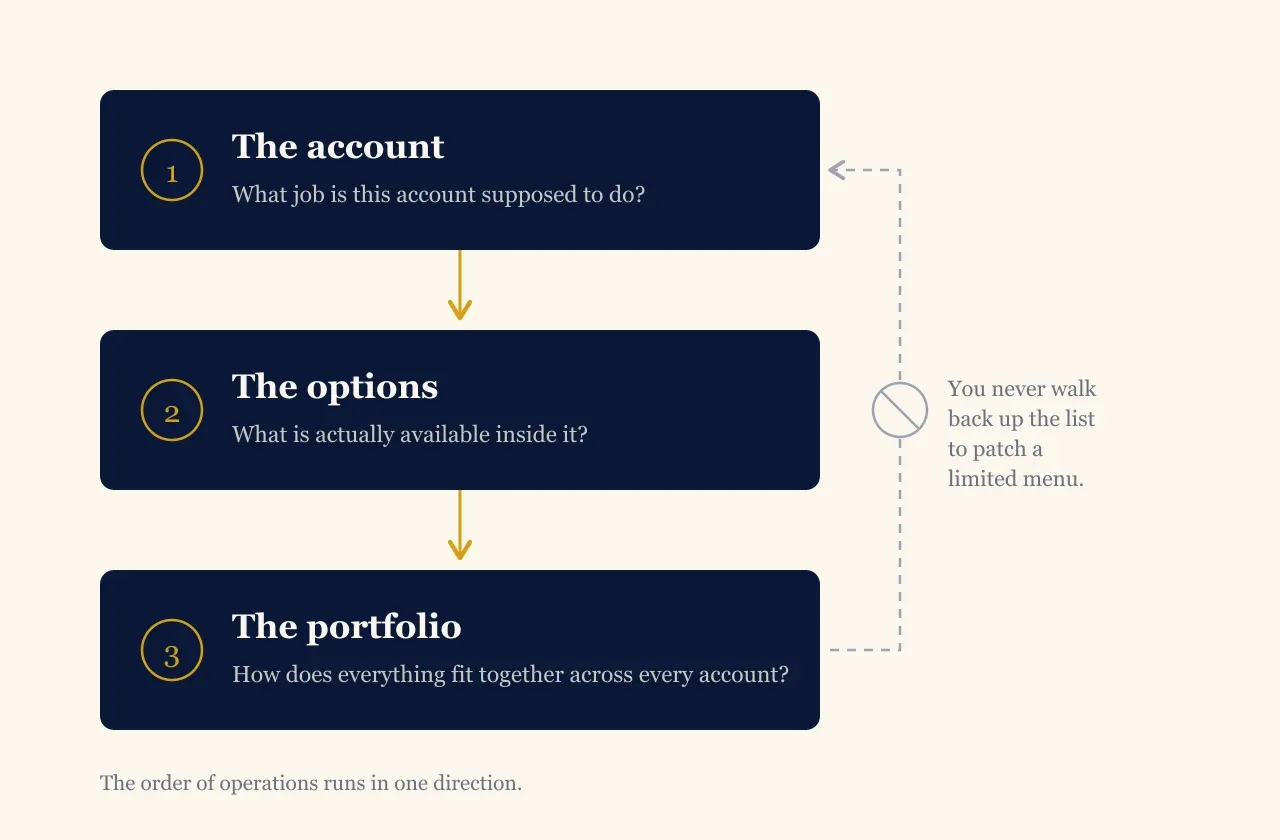
You work down that list, top to bottom, and you do not walk back up it. If your plan has a very limited menu, the fix happens in your IRAs or your HSA, not by forcing your 401(k) to buy a fund it should not own. Teachers and hospital workers get the most limited menu of all, and the same answer applies to a 403(b).
Your 401(k) does not have to be a complete diversified portfolio alone. It has to hold its share of one.
Most advice hands you a pie chart and expects each account to solve every problem by itself. It does not, and it cannot. Your 401(k) portfolio’s job is simply to allocate your contributions to the best option available on that limited menu.
I have looked at hundreds of portfolios that were filled with too many positions, with no direction or strategy behind any of them. A little of this, a little of that, three funds that own the same companies. Portfolio slop.
The people holding them followed an advisor’s recommendations, more sales than rigor, and ended up with a portfolio they could not understand. Little did they know their own portfolio was full of lazy positions actively working against their goals.
None of that complexity is needed. Building a 401(k) portfolio is not an exercise in addition. It is an exercise in subtraction, and it runs on two questions:
What is the job of this account?
What options are available to me?
Answer the first, then use the second to find the cleanest available way to do that job. Then stop. Once you have satisfied those two questions, you don’t need a garnish.
If you are more than 10 years from retirement, your 401(k)‘s job is one word: compounding. Every fund on your menu now has to justify how it will achieve that goal. Most cannot. Just eliminate them.
Advocates of an own-everything portfolio say it keeps you diversified and ensures you win by participating. A reasonable trade, if it were true. So I checked it against 15 years of data on the funds that stand in for the common 401(k) menu categories.
| Fund | Annualized return | Max drawdown | Volatility |
|---|---|---|---|
| Vanguard 500 Index (VOO) | 14.09% | 34.01% | 14.99% |
| Vanguard Total Stock Market (VTI) | 13.62% | 35.00% | 15.53% |
| Vanguard Small-Cap Index (VB) | 10.81% | 42.05% | 19.20% |
| Vanguard Total World Stock (VT) | 10.17% | 34.23% | 15.19% |
| Vanguard Target Retirement (VFORX) | 9.49% | 29.35% | 12.75% |
| Vanguard Total Bond Market (BND) | 2.09% | 18.58% | 4.50% |
Bold marks figures worse than the S&P 500 fund.
The small-cap, total stock market, and total world rows all returned less per year with deeper losses and more volatility than the S&P 500 fund. Not one of those three bought a single thing in exchange for what it gave up.
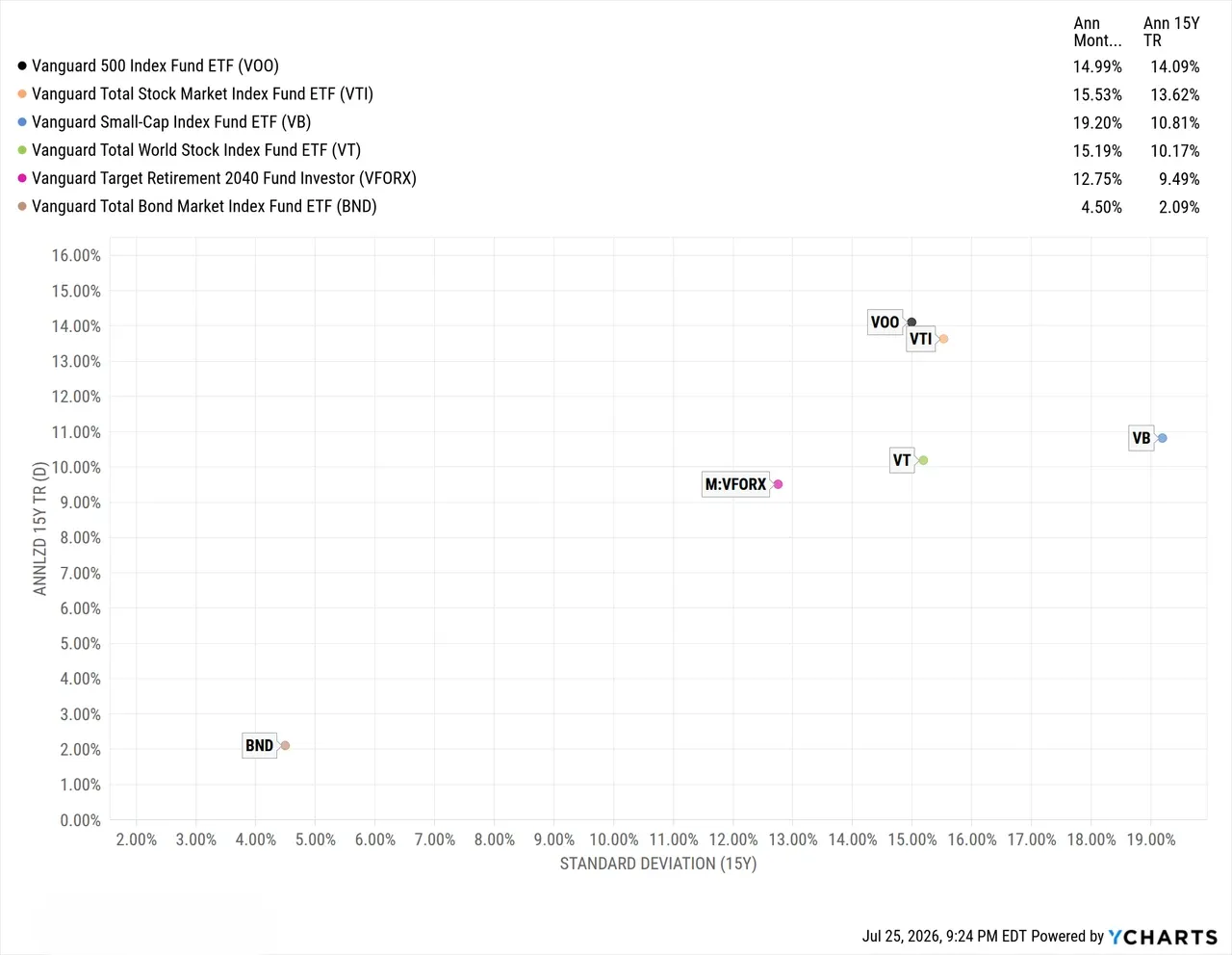
To be fair, the target-date fund was the one clear exception. It did its job: it held up better in the crash, beat the S&P 500 by 4.7 percentage points on the downside, and kept the volatility down.
But look closer. The S&P 500 gave you 0.41 of return for every point of drawdown. The target-date fund only gave you 0.32. That’s 28.1% more return per unit of risk in the S&P 500 fund’s favor. The target-date fund lowered your risk, but it lowered your return more. That’s a rip-off. I lay out the full retirement costs of a target-date fund in Target-Date Fund vs S&P 500: Which One Gets You There Sooner?.
That 15-year window runs from 2011 to 2026. I used that window because the history of Vanguard’s target-date fund isn’t available for longer. It is also fair to say that period favored the S&P 500. What has not changed is why.
The structure that produced it is still in place. Small-cap indexes now carry a large share of unprofitable companies, 42% by last measure. If you want to understand why the market structure changed, read Dead Weight: Zombies in Your Portfolio. International indexes have their own systemic issues. I’ll write more about that in a future article.
Percentages hide the true damage. Time does not.
Let’s say you are 25 years from retirement, contributing the same amount each paycheck. Split that contribution evenly across five common 401(k) funds (an S&P 500 index fund, a total stock market fund, a small-cap fund, a total world stock market fund, and a total bond index fund), and that allocation needs about 30 years and 10 months to reach what an S&P 500 index fund alone reaches in 25 years.
Yes, you drove in traffic, went to pointless meetings, and missed your kids’ school events for an additional five years and ten months. That’s not diversification. That’s a part-time job you didn’t apply for.
Your number will be different. Want to see it?
Your allocation, priced in years.
See what your 401(k) allocation costs you →
Set how far you are from retirement, then build your current allocation. The answer comes back in years and months, not percentages.
Real diversification is not the number of positions you own. It comes from owning things that behave differently from each other. I illustrated that point in detail in The Permanent Portfolio.
Two things move your 401(k) allocation: your retirement stage, meaning how far you are from retirement, and the current macro environment. That is the entire list.
Your age is not a factor. Neither is what you hold in all your other accounts.
| Time to retirement | Main job of your 401(k) | What you should hold |
|---|---|---|
| More than 10 years | Build wealth | 100% low-cost S&P 500 index fund |
| Less than 10 years | Protect what you built | 70% S&P 500 index, 30% stability (stable value by default) |
One hundred percent in a low-cost S&P 500 index fund. Volatility is not the risk at this distance from retirement. Permanent drag is.
Yes, the S&P 500 has concentration risk, and market-cap weighting can let the largest companies become a bigger share of the index than you would choose on your own. I take that risk knowingly inside a 401(k), because the alternatives on a typical menu are worse. The fix for concentration exists, and it lives in your other accounts. More on that below.
Seventy percent stays in the growth engine. Thirty percent moves into stability. What kind of stability? It depends…
| If the inflation environment is… | The 30% should hold… |
|---|---|
| Elevated or rising | A stable value fund |
| Declining | An actively managed bond fund |
Notice what is not in that table: a broad bond index fund. Bond indexes allocate most of your money to the biggest debtors rather than the strongest ones. And when inflation is running hot, stocks and bonds tend to fall together. Your bond fund stops cushioning the drop and starts joining it. That is my argument in Does Your Bond Fund Need Ozempic?.
Not sure which environment you are in? Use stable value. Reading inflation well takes a reliable data source and research experience. Was the latest data point just a blip or a turn? That is a real skill most people do not have and should not have to acquire. Stable value gets you where you need to go. Pick it and move on.
If you are inside 10 years and hold a target-date fund, do this: move the whole balance in one transaction rather than easing in over months. You are not timing a market entry, you are correcting an allocation. Set future contributions to the same 70/30 split the same day.
This is another reason why there is no such thing as set it and forget it. When you sail from California to Hawaii, you do not set your course on day one and go below deck. You adjust course based on data: the prevailing winds, an approaching storm, whatever the ocean is doing right then. The destination never moved. The route did.
Plans without any U.S. large-cap index fund are rarer than the internet suggests. What you likely have is an actively managed large-cap fund sitting where the index fund should be, charging you fifty times the fee for the privilege.
The average actively managed equity fund runs about 0.64% a year against roughly 0.015% for a large index fund. That gap of about 0.625% a year sounds like nothing. But assume the active manager at least matches the index after fees, which most do not, and it still costs a 25-year saver roughly nine months of additional work.
Nine months is real, but it is also one eighth of what the own-everything portfolio above cost. That ratio is the whole lesson.
Fees matter. But structure matters far more.
So take the hit, hold the lowest-cost U.S. large-cap option your plan offers, and spend your attention on the thing that costs years rather than months.
Menus rarely label anything helpfully. Scan the fund names for 500, S&P 500, Large Cap Index, Equity Index, or Institutional Index, then compare expense ratios among whatever matches. If nothing does, call the plan provider and ask which fund most closely tracks the S&P 500 and what it costs.
Federal employees run a five-fund menu with one fund nobody else can buy, covered in your TSP allocation.
Your 401(k) is one account inside your whole retirement plan. It is very good at a few things: a high contribution limit, an employer match, and automatic payroll investing that happens whether or not you remember. It is bad at exactly one thing, and that is choice.
Your IRA and your HSA are the opposite. Smaller limits, unlimited choice. For the HSA specifically, I wrote the setup steps in how to invest HSA funds.
| Account | What it is good at | What it should hold |
|---|---|---|
| 401(k) | High limits, employer match, automatic payroll investing | The growth engine, in the cleanest large-cap option available |
| IRA / Rollover | Unlimited investment choice | Rules-based funds that diversify concentration risk |
| HSA | Unlimited choice, strongest tax treatment | Long-horizon growth plus rules-based funds that diversify concentration risk |
| Taxable | No penalties, full flexibility | Tax-efficient holdings and money needed before 59 1/2 |
If you are deciding which of these to fund first, that is a separate question I answered in HSA vs. Roth IRA vs. 401(k).
In the accounts where you have real choice, I use specific funds that are self-cleaning. A plain index fund holds whatever qualifies for the index and allocates more to the biggest companies. As of July 2026, the top 10 companies account for 40% of the index. And you thought you were diversified.
A self-cleaning fund is an exchange-traded fund (ETF) with a rules-based process sitting on top, filtering and rebalancing every holding once or twice a year. What are the filters? Profitability, cash flow, and price momentum. Only the A students make the cut.
The A students are simply the companies that keep passing those tests. You hold them by design instead of by accident. And the concentration problem takes care of itself, because being huge no longer earns a company a bigger slice.
That is how you deal with the S&P 500’s concentration risk. Not by holding weak funds inside your 401(k), but by diversifying where you actually have options.
Here is the good news about a bad menu. The handcuffs come off, often sooner than you expect.
Escape hatch one: the brokerage window. Some plans let you invest part of your balance outside the standard menu. Fidelity calls it BrokerageLink. If your plan offers one, do not ignore it. One question decides whether to use it: can future contributions be invested automatically? If every paycheck requires you to log in and place a trade by hand, you have just given yourself a job every two weeks, and you will eventually stop doing it. Fees matter too, but automation determines whether the window helps or quietly becomes a chore you ignore. No automation, skip it.
Escape hatch two: the rollover. Almost nobody spends 20 years at one employer anymore. So when you change jobs, do not leave the balance sitting at your old employer. Roll it directly into a traditional or rollover IRA. That removes the handcuffs. The money keeps its tax treatment, nothing becomes taxable, and for the first time that balance can hold whatever it should hold rather than whatever your former employer’s plan committee approved.
That rollover moment is the largest single upgrade most investors ever get, and it routinely sits unclaimed for years because nobody told them it matters. What, you have an old 401(k)? Open a new tab in your browser and roll it over now. Don’t worry, I’ll wait…
Three signs, and any one of them is enough:
The fastest way to settle it is to price it. Put your actual current allocation into the 401(k) allocation calculator and it returns the cost in years and months rather than percentages, which is a unit you can act on.
First, the thing that stops most people before they start: exchanging one fund for another inside your 401(k) is not a taxable event. You are moving money between funds inside a retirement account. No capital gains, no tax bill, nothing to report. The account does not care what you hold, only that you hold it there.
Now log in and open the investment menu.
500, Large Cap Index, or Equity Index in the names. If there is no index option, take the lowest-cost large-cap fund available.That sequence gets you most of the way there. Most of the way beats owning everything.
Want the other 20%?
The steps above are a complete plan for your 401(k). What remains are the optimized holdings for the rest of your portfolio and daily monitoring of market risk that can set you back years.
Gold+ covers that part: the Refined FI portfolio matched to your stage, the specific holdings and weights, and an email when market risk calls for a change instead of leaving you to guess.
Prefer to see it first? Watch the 2-minute look inside Gold+.
By stage, not by age. More than 10 years from retirement, 100% in a low-cost S&P 500 index fund. Inside 10 years, 70% there and 30% in stability, stable value unless inflation is clearly declining.
The smallest allocation that does the account’s job. For most people building wealth, that is one fund. Adding holdings to a 401(k) tends to add drag rather than protection, and over time additions deliver less return with deeper losses.
Exactly the same way you allocate the existing balance. These are two different settings in most plan interfaces, and changing one does not change the other. If you only update the balance, every future paycheck keeps refilling the funds you just removed.
For the wealth-building years, yes. That fund holds 500 profitable companies across every sector, and most of them earn substantial revenue outside the United States. Your 401(k) does not have to be a complete portfolio. It has to hold its share of one.
Not by age. By stage and by environment. A 55-year-old planning to work until 70 and a 55-year-old retiring at 60 need different accounts doing different jobs, and their birth years are identical.
Hold the lowest-cost U.S. large-cap option available and let your IRA and HSA carry what the menu cannot. If the plan offers a brokerage window that can invest contributions automatically, that is a better path. When you change employers, roll the balance into an IRA and the constraint disappears.
If you cannot name the job each holding does, if several of your funds own the same companies, or if you have never changed the default you were enrolled in, it is wrong. Run your current allocation through the 401(k) allocation calculator to see the cost in years and months.
This article is for educational and informational purposes only and does not constitute investment, financial, tax, or legal advice. Refined FI is not a registered investment advisor. Past performance does not guarantee future results. All investing involves risk, including possible loss of principal. Fund performance, drawdown, and volatility figures are 15-year figures as of July 25, 2026, and specific funds are used as stand-ins for common plan-menu categories; your plan’s options will differ. The years-and-months comparisons extend historical annualized returns as constant-rate scenarios and are not forecasts. Fund expense averages are 2024 industry figures. Plan rules, fees, and contribution limits change; verify your current plan documents. Refined FI receives $0 in compensation from any fund company mentioned.
A little of everything is not a portfolio. Here is the 401(k) allocation by stage, and what belongs elsewhere.
19 min read
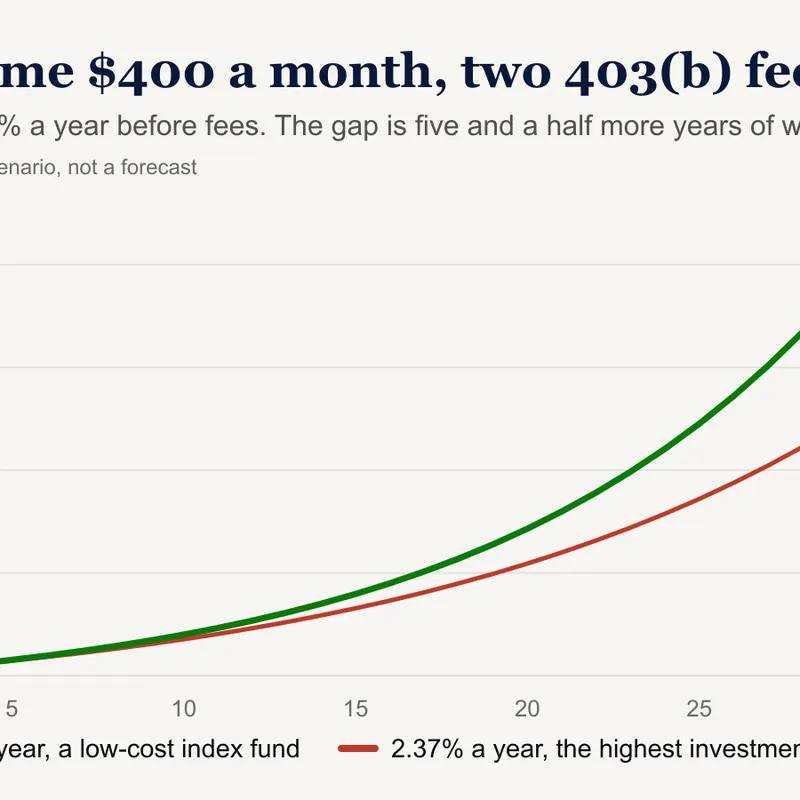
I used to sell 403(b) annuities to teachers, but not anymore. What I learned to do and what NOT to do could save you years off your retirement date.
20 min read

Target-date fund vs S&P 500, run on real returns. One of them took 4.5 to 5.6 years longer to get you to the same number.
13 min read