

Your 401(k) Portfolio: One Job, One Fund, and Where the Rest Belongs
A little of everything is not a portfolio. Here is the 401(k) allocation by stage, and what belongs elsewhere.
19 min read
Key Takeaways
You will have to work over 5 years longer with the L 2040 Fund. That’s how much longer it would take to reach $1 million than the C Fund, at the returns each one has actually delivered over the last 10 years. Same paycheck. Same contribution. Same five funds on the menu. One box ticked differently.
| Fund | 10-year return | Years to $1 million | Extra years |
|---|---|---|---|
| C Fund | 15.34% | 18.3 | 0.0 |
| S Fund | 11.73% | 21.8 | 3.5 |
| L 2040 Fund | 10.48% | 23.4 | 5.1 |
| I Fund | 10.46% | 23.5 | 5.2 |
The scenario starts at $0, adds $833.33 at the end of every month, and measures how long each fund would take to reach $1 million if its average annual return from the last 10 years continued. That is a historical-rate scenario, not a forecast, and it is the same test I ran on target-date funds in a 401(k). Same result, different fund names.
So here is how you allocate your TSP:
| Years to retirement | The job | Your TSP |
|---|---|---|
| More than 10 | Build wealth | 100% C Fund |
| Less than 10 | Protect what you built | 70% C Fund, 30% G Fund |
| About a year or less | Cover the gap your pension leaves | G Fund as your stability side, growth outside the TSP |
Within about a year of retiring, the strategy changes, and I will get to that below.
This is the same answer I give private-sector workers in a 401(k), and I’ve made the full case for it twice already: once on why a target-date fund costs you years, and once on how to structure the whole account. The reasoning doesn’t change because your employer is the federal government. The fund names change.
Search for this and the top result is a Reddit thread where six people give six different answers, while the government’s own site describes each fund and never recommends one. You have a menu of five. Here is what each one has actually done.
The TSP is a restaurant with five things on the menu. No substitutions, no specials. That is good news, because it means there are only five decisions and you can hold all of them in your head at once.
| Fund | What it actually is | Cost | 10-year return |
|---|---|---|---|
| C Fund | The S&P 500. The same index, nothing different | 0.035% | 15.34% |
| S Fund | Small and mid-size U.S. companies the S&P 500 leaves out | 0.051% | 11.73% |
| I Fund | International stocks, outside the U.S. | 0.048% | 10.46% |
| F Fund | The broad U.S. bond market | 0.035% | 1.49% |
| G Fund | Government securities. Cannot lose money | 0.034% | 2.94% |
Average annual returns as of August 2026, from tsp.gov.
The C Fund is the S&P 500 at 0.035% a year, which is cheaper than almost anything a private-sector worker can buy. And the G Fund beat the F Fund over 10 years while carrying none of the risk.
The job of your TSP while you are working is compounding. Every fund on that menu has to justify itself against the S&P 500, and three of them can’t. The 30% is where the TSP beats every 401(k) in the country.
In a 401(k), the stability side is a compromise. You get a stable value fund if you’re lucky, a broad bond index fund if you’re not, and I’ve written about why a bond fund near retirement often isn’t the safety you think you bought.
Federal employees get something better, and it is not a close call.
The G Fund holds short-term Treasury securities issued specially to the TSP, and it pays a rate set each month from the average yield of Treasury notes and bonds with four or more years to maturity. That combination doesn’t exist anywhere else. You get long-term interest rates on an investment whose price never falls. Not “rarely falls.” Never. There is no market risk, no credit risk, and no bad quarter.
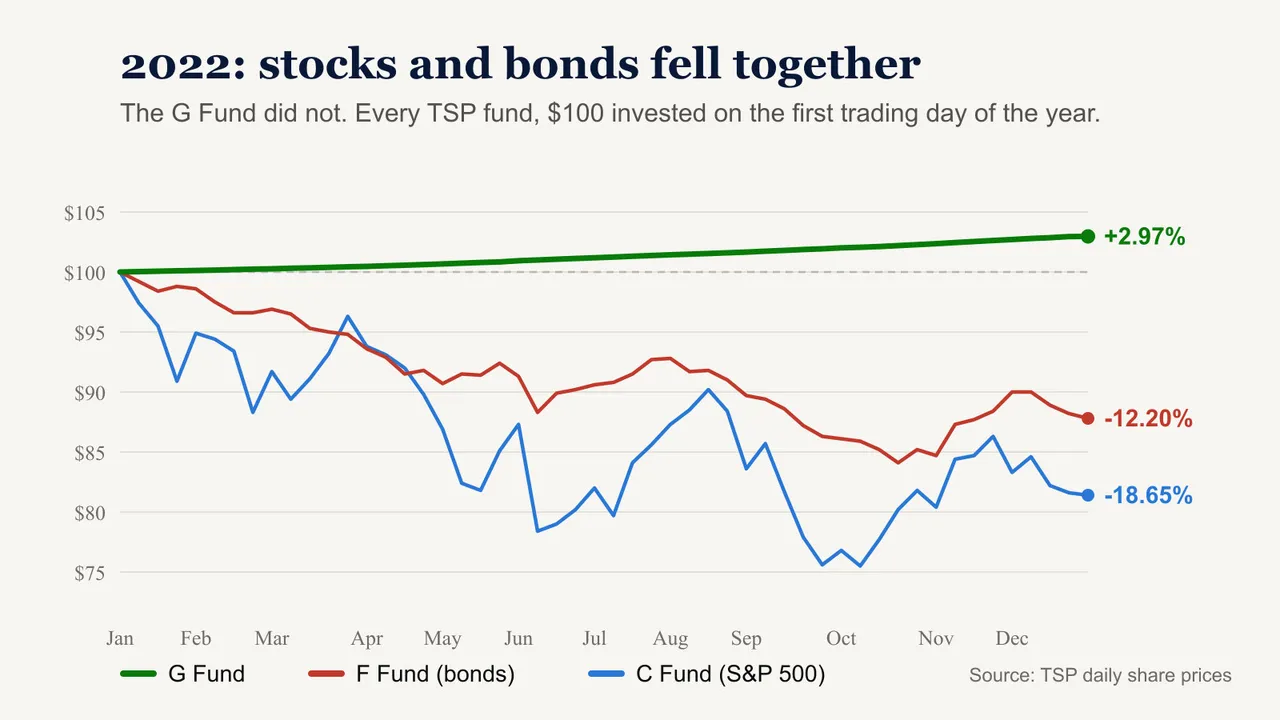
2022 settles it.
| 2022 | Return |
|---|---|
| G Fund | +2.97% |
| F Fund (bonds) | −12.20% |
| C Fund (S&P 500) | −18.65% |
| S Fund | −26.60% |
| I Fund | −13.74% |
That was the year stocks and bonds fell together, which is the one thing your safe half is not supposed to do. Say you were five years from retirement with $500,000 in your TSP and 30% of it, $150,000, on the stability side. In the F Fund that $150,000 lost $18,300 while your stocks were losing 18.65%. Both halves went down at once. In the G Fund it gained $4,455. The two answers are $22,755 apart, in one year, on the part of your money that was supposed to be safe.
The G Fund’s worst day of 2022 was the day the year started, because it never once closed below where it opened. Same story in 2020. The C Fund fell 31% below its January level that March, and the G Fund’s line runs flat straight across the top of the crash.
Over the last 10 years the pattern holds on average too. The G Fund returned 2.94% a year and the F Fund returned 1.49%, and only one of them can lose money.
You cannot buy the G Fund. Not through Fidelity, not through Vanguard, not through a financial advisor, not for any amount of money. It exists only inside the Thrift Savings Plan and only while your money is in it.
This is a gift. Don’t squander it.
The L Funds are target-date funds wearing government clothes. Pick your retirement year, and the fund rebalances across all five funds every day, getting more conservative as the date approaches. One decision, made once, and you never think about it again.
Here is what you’re actually holding in the L 2040 Fund, as of July 2026:
| Fund | L 2040 holds |
|---|---|
| C Fund | 37.31% |
| I Fund | 25.11% |
| G Fund | 21.56% |
| S Fund | 9.33% |
| F Fund | 6.69% |
A quarter of your money is international. That’s nearly three times the small-cap position, in a fund that returned 10.46% a year over the last decade while the C Fund returned 15.34%.
The L 2040 Fund returned 10.48% a year over 10 years. The C Fund returned 15.34%. That gap is the five years in the first table, and it is the price of diversification you were handed without being asked.
The daily rebalancing makes it worse. When large-cap U.S. stocks outperform, rebalancing sells the thing that is working and buys more of the thing that isn’t. Every fund that rebalances does this; the L Funds just do it more often than anyone else. A fund that rebalances once a year gives a winning position 12 months to run. A fund that rebalances daily gives it until tomorrow.
If you want to understand why I don’t reach for small-cap indexes either, that argument is here.
Everything above is pre-retirement portfolio construction. It answers one question, which is how you build this thing up.
Once you are about a year out, you are solving a different problem, and the answer stops coming from a table.
Now you sum what you have coming in. FERS pension. Social Security. Any other guaranteed income. Those are checks that arrive whether the market cooperates or not, and they cover some portion of what you plan to spend.
Then you ask what the rest of your money actually needs to provide. If your pension and Social Security cover most of your spending, the gap your portfolio has to fill is small, and you do not need to take much risk to fill it. If the gap is large, even with a pension, that changes what you hold. It goes back to your burn rate and nothing else, and that is a number you cannot do in your head. Run yours here. It takes your pension and Social Security off the top and tells you what your own money has to cover.
Once you have that number, the G Fund’s job gets bigger than 30% of your TSP.
Your TSP is not your whole retirement portfolio. You likely have an IRA, a taxable account, or both. So stop thinking about the TSP as a portfolio and start thinking about it as one sleeve of a larger one.
The G Fund is the stability side. Of everything you own, not only your TSP. Move your TSP to the G Fund and let it do the job no other account can do as well. Then build the growth side outside it, in the accounts where you have real choice, aligned to the Refined FI portfolio for your stage. Your stability is the best stability in the country. Your growth is unconstrained by a five-item menu.
That is the process I would follow. Which half needs to be how big comes from your burn rate.
When you leave federal service, an advisor will tell you to roll your TSP into an IRA. More choice, they’ll say. More flexibility.
Do that with the whole balance and the G Fund is gone. Permanently. There is no version of it on the outside and no amount of money that buys one back. You will trade the only fund in America that pays long-term government rates without price risk for a bond fund that lost to it over the last decade.
There is a second thing you give up. Leave federal service in or after the year you turn 55, and you can take money out of the TSP with no early withdrawal penalty. For law enforcement officers, firefighters, and air traffic controllers, that age is 50. Roll the money to an IRA and that goes away; you’re back to waiting until 59 and a half.
Keep the TSP. Move the growth side out if you want the choice. The stability side stays.
The G Fund protects your balance. It does not protect what your balance buys.
If the G Fund pays you 4% and inflation runs at 4%, you have earned nothing. Your account statement looks healthy and your purchasing power has flatlined. That’s the whole risk, and it’s the reason the stability side of a portfolio is never a decision you make once.
You are close enough to needing this money that a decade of quiet erosion matters. You do not need to become an economist to watch it. Gold+ members get the Risk Monitor, which checks conditions daily and emails you when guidance calls for a portfolio action, including the day the stability side needs to change. See what members get.
The TSP has two separate settings:
Change the first and your existing balance sits exactly where it was. People do this all the time, feel like they’ve fixed their portfolio, and discover years later that most of their money never moved.
Nobody is watching your TSP, least of all the L Fund inside it.
Gold+ connects your plan, portfolio, and protection in one system. See whether you’re behind, on track, or ahead, follow the Refined FI portfolio built for your stage, and get an email when market risk calls for a change.
Prefer to see it first? Watch the 2-minute look inside Gold+.
More than 10 years from retirement, 100% C Fund. Inside 10 years, 70% C Fund and 30% G Fund. Within about a year of retiring, the answer comes from your burn rate instead of a table: count your pension and Social Security, work out what your remaining money has to provide, and build to that.
No. The L 2040 Fund holds 25.11% international against 9.33% small-cap, and returned 10.48% a year over 10 years against the C Fund’s 15.34%. At those returns it takes about five years longer to reach $1 million. You’re paying for diversification you didn’t choose.
In 2022 the F Fund lost 12.20% and the G Fund gained 2.97%. Over the last 10 years the G Fund returned 2.94% a year and the F Fund returned 1.49%. The F Fund can lose money and the G Fund cannot. Inside the TSP, I see no case for the F Fund.
It stays available as long as your money stays in the TSP. Roll the balance to an IRA and you lose access permanently, because the G Fund cannot be bought outside the plan.
Only through the gap it leaves. A pension is not a giant bond you can lean on. It covers part of your spending, and the size of what it doesn’t cover is what decides how your remaining money is invested.
Two settings, both at tsp.gov. Change your contribution allocation to redirect future paychecks, then request a reallocation to move your existing balance. Doing one and not the other is the most common mistake federal employees make with this account.
This article is for educational and informational purposes only and does not constitute investment, financial, tax, or legal advice. Refined FI is not a registered investment advisor. Past performance does not guarantee future results. All investing involves risk, including possible loss of principal. Fund returns, expense ratios and L Fund allocations are from tsp.gov as of August 2026; the 2022 and 2020 figures are computed from TSP daily share prices. The years-to-$1-million comparison extends each fund’s 10-year average annual return as a constant-rate scenario and is not a forecast. Plan rules and withdrawal ages change; verify them against tsp.gov and your own situation. Refined FI receives $0 in compensation from any fund or plan mentioned.
A little of everything is not a portfolio. Here is the 401(k) allocation by stage, and what belongs elsewhere.
19 min read
I used to sell 403(b) annuities to teachers, but not anymore. What I learned to do and what NOT to do could save you years off your retirement date.
20 min read
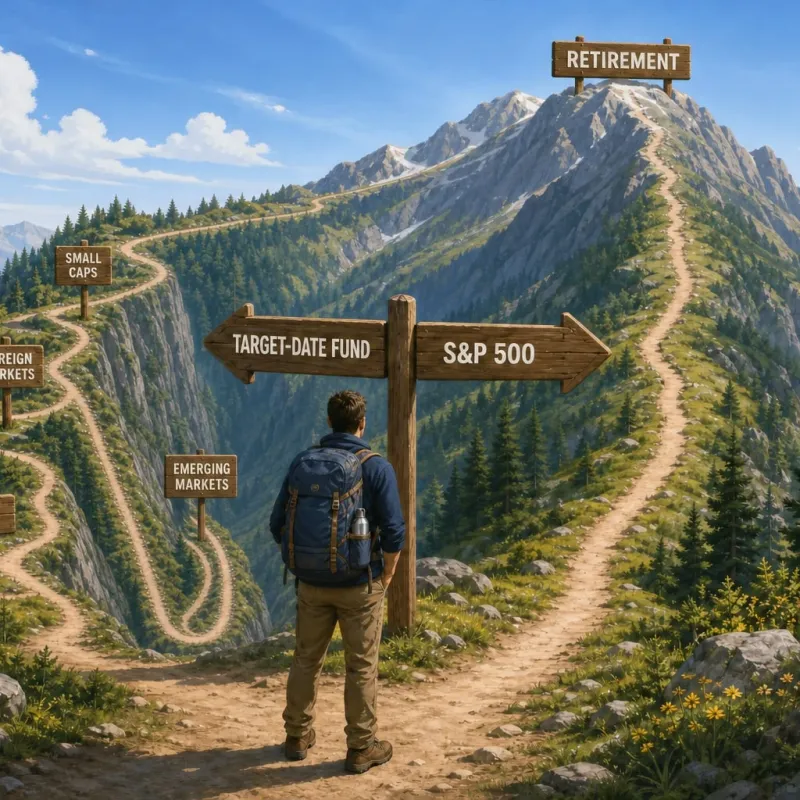
Target-date fund vs S&P 500, run on real returns. One of them took 4.5 to 5.6 years longer to get you to the same number.
13 min read