

Your 401(k) Portfolio: One Job, One Fund, and Where the Rest Belongs
A little of everything is not a portfolio. Here is the 401(k) allocation by stage, and what belongs elsewhere.
19 min read

Key Takeaways
Every open enrollment, your benefits portal puts two accounts side by side. Health Savings Account (HSA). Flexible Spending Account (FSA). Nearly the same acronym, the same “pre-tax dollars for medical expenses” description, the same reassuring blue icons.
They are not related. They are not even the same species.
One is a retirement account wearing a disguise. The other is a spending account with a shredder attached, scheduled to run every December 31st.
Search “HSA vs FSA” and you get feature tables from Fidelity, Vanguard, and half the insurance industry, and every one of them ends the same way: “it depends on your situation.” For most people reading this, it does not depend. The decision has a rule, and the rule fits in two sentences.
Here is the rule I give friends:
If you are healthy and your employer offers a high-deductible health plan, take it, open the HSA, and skip the health FSA entirely. It’s an illusion of choice: one builds wealth, the other delays it.
The one honest exception: chronic medical conditions with large, predictable costs. If you know you will hit your deductible every single year, a traditional copay plan can beat the high-deductible plan, and in that world a health FSA can make sense as a way to pre-tax the bills you know are coming. That is a real situation, and if it is yours, run your plan’s actual numbers.
Everyone else is standing at a fork on the path, but one path is a dead-end. One path leads to an account you will still own at 65 stuffed with money. The other leads to an account that will eat your unused money every December.
The HSA is the best retirement account out there. But it’s a superhero wearing a mask. The name says health, the debit card says spending, but the tax code says best wealth building engine.
The HSA is the only account that can bypass taxes three times. Money goes in pre-tax, compounds untaxed, and comes out tax-free for qualified medical expenses. In addition, if funded through payroll it can skip Social Security and Medicare taxes too. No 401(k) does that. No Roth IRA does that. I ran the full comparison in HSA vs Roth IRA, and the execution playbook is in How To Invest HSA Funds. The short version: contribute through payroll, invest the balance automatically, pay ordinary medical bills from checking, and save the receipts for years.
For 2026, the IRS lets you put $4,400 into your HSA with self-only coverage or $8,750 with family coverage, plus $1,000 more at age 55 or older, per IRS Revenue Procedure 2025-19. Every dollar of it is yours forever. It rolls over every year, it moves with you when you change jobs, and it compounds the entire time.
Put family-level contributions to work and the disguise really comes off. Contribute $8,750 a year for 15 years at a 7% annual return and your account grows to roughly $220,000. That is retirement money that can also pay Medicare premiums, dental work, and decades of saved-up receipts, all tax-free. Turning 65 changes the rules on that account, and HSA After 65 has the timeline.
Your employer’s health FSA lets you set aside up to $3,400 in 2026, per the IRS’s 2026 inflation adjustments. Spend it on qualified medical costs during the year and you saved income tax on those dollars. So far, so good.
Now the edge of the knife:
To be fair, the FSA has one genuine advantage: your full election is available on day one. Elect $3,400 in January and you can spend all of it in February, before you have contributed most of it. If you leave the company after that, your employer eats the difference. It is the one place the knife cuts in your favor.
But here is what the feature tables never tell you: an FSA is a low-grade worry you have to keep in the back of your mind all year. Did I spend enough? Will they accept this receipt? Is there money left I forgot about? You took on a part-time bookkeeping job to save a few hundred dollars in tax, and one distracted December can wipe out the whole benefit.
I know because I lived it.
When my kids were in preschool, I had an HSA I was neglecting and a dependent-care FSA on top of it. The dependent-care FSA is the one version of this account I would use again, and it still fought me.
Your first fight is receipts. An FSA reimburses documented care from a provider willing to put it in writing. If someone watches your kids off the books and wants cash, you are not getting reimbursed, and plenty of casual caregivers will not produce paperwork. The administrator decides what counts, and they are strict, because forfeited money is good for the plan and bad for you. One December they rejected a claim of mine over how the receipt was formatted. The rollover from that year, a two-digit amount, died on the table. Small money, big lesson.
Your second fight is the tax credit you give up. A dependent-care FSA and the Child and Dependent Care Tax Credit draw from the same pool of expenses, and the IRS makes you subtract your FSA contributions from the expenses eligible for the credit on Form 2441. With one child, the credit covers up to $3,000 of expenses, so maxing your FSA wipes the credit out completely. With two or more kids, the credit covers up to $6,000, so a full $7,500 FSA election erases it, while a smaller election leaves the gap claimable. Starting in 2026 the dependent-care FSA limit rises from $5,000 to $7,500, which makes the mistake of blindly maxing it more expensive, not less.
My rule now: use a dependent-care FSA only when you have kids or a parent in documented, paid care, and fund it below what you expect to spend. The under-funding is deliberate. Every dollar you elect is a dollar you must successfully claim, from a provider who cooperates, through a plan that keeps whatever you fail to claim. Leave yourself margin for the year not going to plan, because it won’t.
You will see this in every FAQ, so let me answer it with the actual rule from IRS Publication 969: a regular health FSA blocks HSA contributions. Even at a zero balance, it counts as disqualifying coverage. Your spouse’s health FSA can block you too.
The one legal combination is a limited-purpose FSA, restricted to dental and vision, sitting alongside your HSA. Benefits brochures present it like a bonus level you unlocked.
Skip it. It’s not a choice. It’s a false choice. It’s a rope-a-dope. A limited-purpose FSA dollar must be spent on near-term dental and vision or it forfeits, so at its very best it is tax-free spending on bills you already knew were coming. It is never saving. Meanwhile you have added a second account to track, a second use-it-or-lose-it clock, and a second administrator to argue with, all to shave tax off a pair of glasses. Put your energy into maxing your HSA instead. A dependent-care FSA is a different animal, by the way: it is not health coverage and never interferes with your HSA.
Every HSA vs FSA article frames this as a money decision: this many dollars of tax saved here, that many dollars there. That framing completely misses the point. You’re losing time, not just dollars.
You have one pool of dollars after the essentials, and everything competes for it: investing, pay extra to the mortgage, the kids, and travel. A dollar you elect into a health FSA comes off the top of that pool and buys you nothing toward financial independence. It is gone in twelve months, best case on bills, worst case forfeited. A dollar into your HSA is invested, compounds tax-free, and shortens your retirement date. Same paycheck deduction on the same screen. One is spending with a discount. The other is taking years off your financial independence number.
So let me stop alluding to it and put a number on it.
Take a household with a $2,000,000 retirement number, already saving $22,500 a year, earning 7% a year on the money. Here is when they finish, depending on one open enrollment decision they repeat every year:
| Where your money goes | Years left to work | Time gained |
|---|---|---|
| Health FSA, $3,400, spent | 29 years 3 months | Nothing. Zero months. |
| Self-only HSA, $4,400, invested | 27 years 0 months | 2 years 3 months |
| Family HSA, $8,750, invested | 25 years 2 months | 4 years 1 month |
Look at the top row before the bottom one. Maxing your health FSA every year for a career doesn’t move your retirement date. Not even a day. Nothing. A spending account cannot buy time by design: you either spend the money that year or you forfeit it.
Now the bottom row. The same employer election screen, a different box, and you retire four years earlier.
Four additional years with sand between your toes, free from pointless meetings.
A career is abstract, so shrink it to a single decision.
Put $8,750 into your family HSA this year, invest it, and never add another dollar. At 7%, twenty-five years later it is worth about $47,500. If you plan to spend $80,000 a year in retirement, that one contribution funds about seven months of it.
One open enrollment. Seven months of your life.
Run that same year through a health FSA and you paid some medical bills with pre-tax dollars, which is genuinely fine, and you bought zero months.
Check the arithmetic yourself. Multiply your contribution by 1.07 for each year you leave it alone, and $8,750 held for 25 years comes to about $47,500. Divide that by the $80,000 a year you plan to spend and you get roughly six-tenths of a year, which is seven months. Change the return, the years, or your spending and the answer moves, but the shape does not: FSA dollars are worth zero years no matter what you plug in, because they never make it out of the plan year.
That is the real comparison, and it is why “it depends” is the wrong answer. When one option touches your retirement date and the other one can’t, you don’t need a feature table.
At your next open enrollment, in order:
Already locked into the wrong setup this year? Don’t worry about it. Enrollment comes back around every year. Spend down your FSA so nothing forfeits, and make the switch the next time the portal opens. Have your plan ready before that window: know your contribution amount, know where the money invests, and automate all of it.
The HSA, and for most healthy people it is not close. Your HSA is a permanent, portable, investable account with a tax advantage no retirement account matches. An FSA is a one-year spending account that forfeits what you fail to claim. The FSA only wins when chronic, predictable medical costs make a traditional copay plan the right insurance choice.
For a household with a $2,000,000 target already saving $22,500 a year at a 7% return, maxing a family HSA at $8,750 a year gets them there 4 years and 1 month sooner. A self-only HSA at $4,400 buys 2 years and 3 months. A maxed health FSA buys nothing, because that money is spent or forfeited inside the plan year. Your own numbers will differ; the direction will not.
A regular health FSA disqualifies you from HSA contributions, even with a zero balance, and a spouse’s health FSA can disqualify you too. The only combination the IRS allows is a limited-purpose FSA for dental and vision alongside an HSA. I recommend skipping it: it adds a second use-it-or-lose-it account to manage for a small, spending-only benefit. See IRS Publication 969.
It is forfeited to your employer, who most often uses it to cover the plan’s administrative costs. Your employer may allow up to $680 to carry into 2027, but carryover is optional plan design, not a right. If you leave your job mid-year, you can only claim expenses incurred before your last day of work.
The price of admission: you must be on a high-deductible health plan, which means paying more out of pocket before insurance steps in. For a healthy household that trade is worth it. For someone with expensive, recurring medical needs, hitting the full deductible every year can cost more than the HSA saves, and that is the one situation where I would choose the copay plan and pass on the HSA.
They pull from the same expenses, so contributions to the FSA reduce what the credit can cover. With one child the credit tops out at $3,000 of expenses; with two or more, $6,000. A maxed $7,500 dependent-care FSA wipes the credit out either way. The FSA saves at your marginal tax rate while the credit pays a percentage set by your income, so which one wins depends on your bracket. Run your numbers on Form 2441 before you pick an election amount.
You just priced one benefits decision in years. Now price the whole plan.
Gold+ connects your plan, portfolio, and protection in one system. See whether you’re behind, on track, or ahead, follow the Refined FI portfolio built for your stage, and get an email when market risk calls for a change.
This article is for educational and informational purposes only and does not constitute investment advice, financial advice, tax advice, legal advice, or a recommendation of any specific health plan, HSA provider, or investment. Refined FI is not a registered investment advisor. HSA and FSA eligibility, contribution limits, carryover rules, payroll deduction rules, and tax credit interactions can change. Investment returns are not guaranteed, and the 7% return used in the examples above is an illustration, not a projection. Consult a qualified tax professional before making tax decisions. Refined FI receives $0 in affiliate revenue, commissions, or compensation from Fidelity or any provider mentioned in this article.
A little of everything is not a portfolio. Here is the 401(k) allocation by stage, and what belongs elsewhere.
19 min read
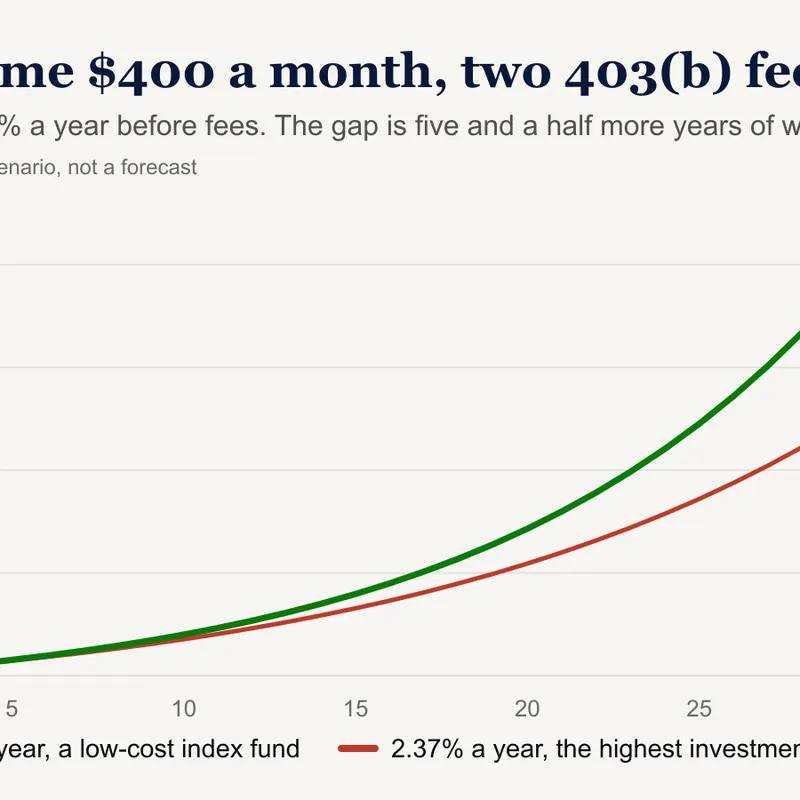
I used to sell 403(b) annuities to teachers, but not anymore. What I learned to do and what NOT to do could save you years off your retirement date.
20 min read

Target-date fund vs S&P 500, run on real returns. One of them took 4.5 to 5.6 years longer to get you to the same number.
13 min read