

Your 401(k) Portfolio: One Job, One Fund, and Where the Rest Belongs
A little of everything is not a portfolio. Here is the 401(k) allocation by stage, and what belongs elsewhere.
19 min read
Key Takeaways
When people go looking for the best 401(k) investments, they are trying to answer one question:
What fund should I actually pick?
Most articles dodge it. Big firms rarely give you a direct answer. Their websites read like they were written by 1,000 attorneys. Everything is technically accurate, carefully hedged, and almost useless when you are staring at your 401(k) menu trying to make a decision before your next paycheck hits.
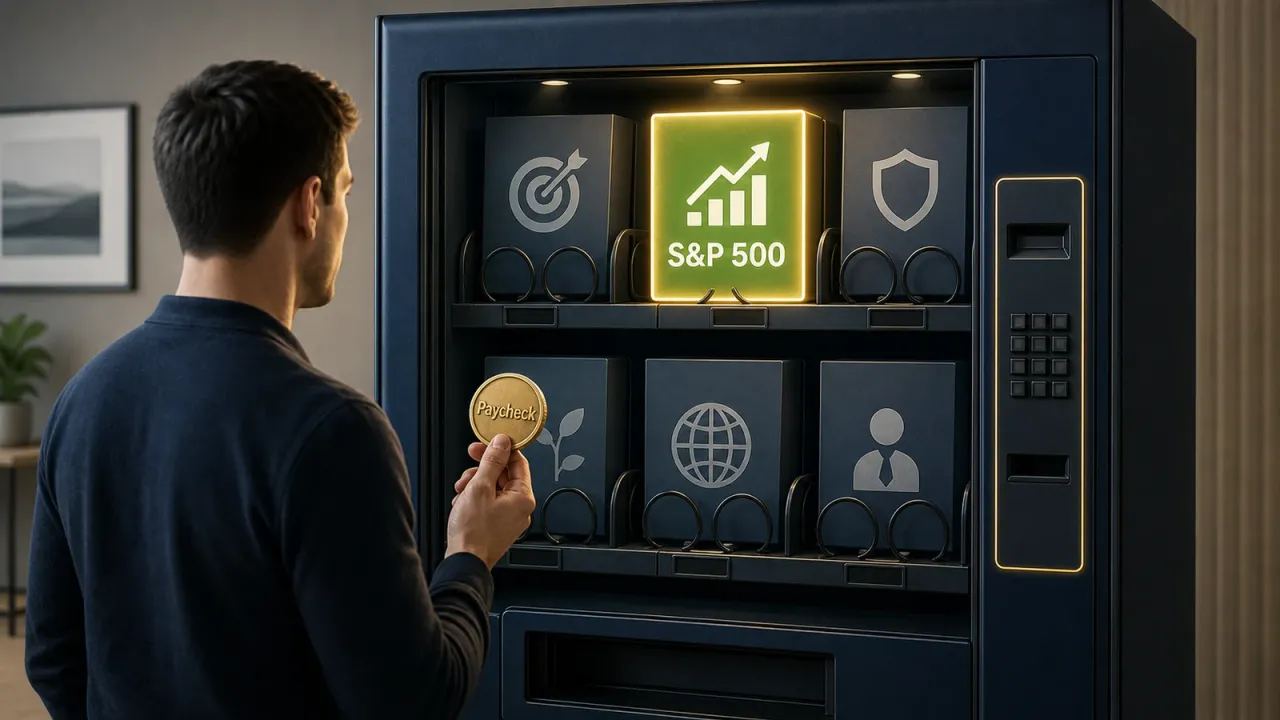
So here is the direct answer: if you are more than 10 years from retirement and still building wealth, the default choice inside your 401(k) should be:
low-cost S&P 500 index fund.
If your plan has that fund, align both your current investments and future contributions into it. I’ll show you where to make both changes below. That is the cleanest default for your wealth-building years.
Once you are less than 10 years from retirement, the job starts to change. You are no longer solving only for growth. You are also managing drawdowns, cash flow, sequence risk, and the timing of your retirement date.
| Time To Retirement | Main Job of 401(k) | 401(k) Default Holding |
|---|---|---|
| More than 10 years | Build wealth | 100% S&P 500 index fund |
| Less than 10 years | Prepare for retirement | 70% S&P 500 index fund / 30% stable value fund |
Notice I said stable value fund (or short-term bond fund), not a broad bond index fund. In a higher-inflation environment with elevated stock-bond correlation, broad bond funds may not reduce risk the way investors expect. Inside a 401(k), we have very limited options. Although not perfect, a stable value fund is the least bad option. Why you keep contributing when the market falls, and what stopping costs, is in How to Protect Your 401(k) From a Market Crash.
Gold+ members get the full Accumulation and Glidepath portfolios, plus retirement planning calculators. The simple table above is not the entire retirement plan, but it is a much better starting point than blindly choosing a target-date fund.
A 401(k) is not a brokerage account with every exchange-traded fund (ETF), a basket of investments that trades like a stock, in the world. It is a limited menu your employer and plan provider gave you. Your job is not to use every option. Your job is to find the best available part for the account’s purpose.
Here is a real example of what that menu can look like:
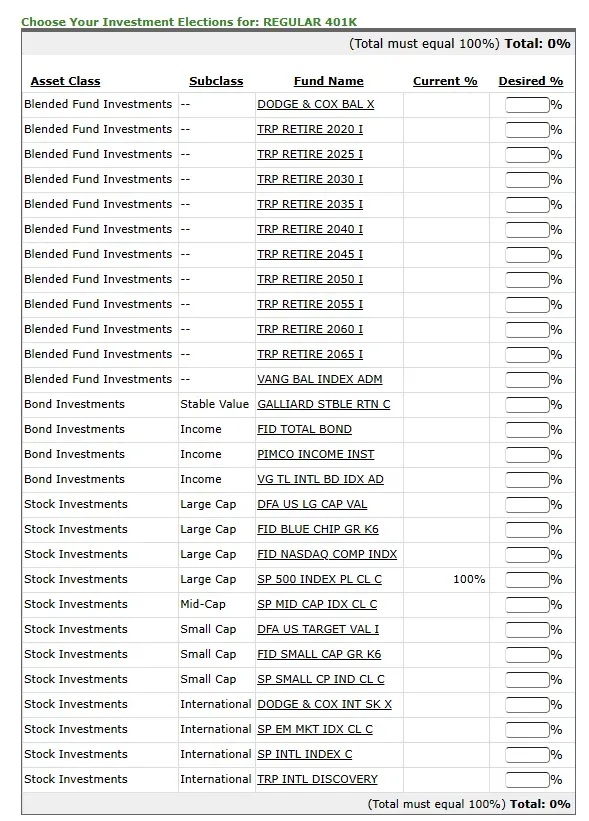
That looks like a lot of different options, but most of those funds are distractions. For a 401(k), the primary job is simple:
Build wealth.
That means you want the cleanest equity growth engine available, not a little bit of everything just because the menu offers it.
Before you change anything, find out what your current allocation is costing you.
Check your 401(k) allocation →
Tell it how far you are from retirement, then set your current allocation. If the answer makes you question what you are doing, don’t worry, I’ll give you a plan.
If your workplace plan is the federal Thrift Savings Plan, the same logic applies with different fund names, and the TSP version is here. If you work for a state or local government, you may also have a 457 sitting beside your main plan, and the order you fill them decides how early you can stop.
Before you look for anything, understand what you are looking at. The plan provider and your HR department are straddling a line. They want the list to carry a lot of different options, so it looks like real diversification and looks like someone is looking out for the employees. All of that extra stuff is excess. It is a rope a dope.
So treat the list as a puzzle rather than a menu. Think of one of those fun little puzzles when you were a kid, trying to find the hidden picture of the spoon on the page. That’s all this is. You’re looking for that pattern to match.
Here is the pattern.
Your plan will almost never print S&P 500 on the line. It prints something like TRP LRG CAP GR TR D and leaves you to work it out. So scan the list for any of these instead:
Any one of those is a candidate. Usually two or three names on the list will match.
A tell is to look for the fund with one of the lowest fees. It will be number one or number two.
That works because an index fund costs a fraction of what everything else on the list costs. A Fidelity 500 Index Fund runs about 0.015% a year. The average actively managed equity fund ran about 0.64% in 2024. When you rank your plan’s funds cheapest first, the index fund floats to the top on its own.
You can see the fee in two places. Your plan has to send you a fee disclosure every year listing what each fund charges. It is also usually printed on the fund’s own description page inside your plan’s website.
A name that matches and a fee near the bottom of the list is your answer.
The table above puts 30% into a stable value fund once you are less than 10 years from retirement. A stable value fund hides behind its own set of words. Scan for:
If you are more than 10 years out, skip this step. You do not need it yet.
That is rare nowadays, but it does happen. Use a large cap fund, a US large cap fund. Next up would be a total stock market index fund. That’ll get you close.
If none of those are there either, the 401(k) Decision Filter further down this page covers every case in order, including the brokerage window.
Most 401(k) platforms separate the money already invested from future paycheck contributions. That means you need to make two changes: move the existing balance, then redirect new contributions.
Changing future contributions does not move the money already sitting in the account. First, move the existing balance into the default holding from the table above.
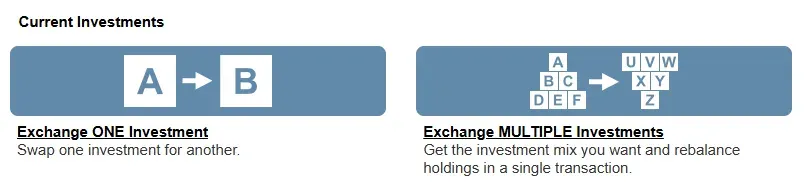
Look for language like exchange investments, rebalance, change current investments, or transfer among funds.
In Fidelity, it can look like this:
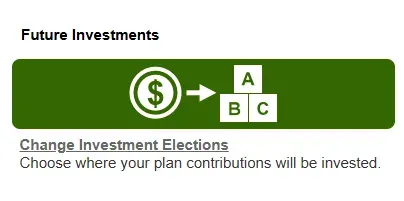
Next, redirect future paycheck contributions into the same default holding from the table above. This may be labeled change investment elections, future investments, contribution allocations, or investment elections.
In Fidelity, it can look like this:
If you skip it, future contributions keep flowing into the old funds, and your 401(k) can slowly become misaligned again.
The process is simple:
Then go do something fun. Walk. Garden. Have a beer. Whatever.
If you want to optimize all your wealth-building accounts and understand how they interact, Gold+ helps you decide where each retirement dollar should go across your 401(k), IRA, HSA, taxable account, cash reserves, and retirement plan.
Gold+ also helps you decide what to do with old 401(k)s, including whether a direct rollover into a Rollover IRA belongs in your broader retirement map.
Inside Refined FI, every investment has to justify itself against the low-cost S&P 500. That matters inside a 401(k) because the menu is often limited, and every weaker option creates drag.
If your plan offers a low-cost S&P 500 index fund, it gives you the core ingredients you want inside a 401(k): large profitable U.S. companies, broad sector exposure, simple implementation, low fees, and a strong long-term compounding track record.
It also avoids several common sources of 401(k) drag: small-cap drag, target-date fund bloat, and active managers charging you for the chance to underperform.
The S&P 500 is not risk-free. It will fall. Sometimes a lot. But if you are more than 10 years from retirement, volatility is not the enemy. Permanent drag is the enemy.
That drag shows up when you compare common 401(k) building blocks against the S&P 500. Adding more ingredients did not create a better 401(k). It created more drag.
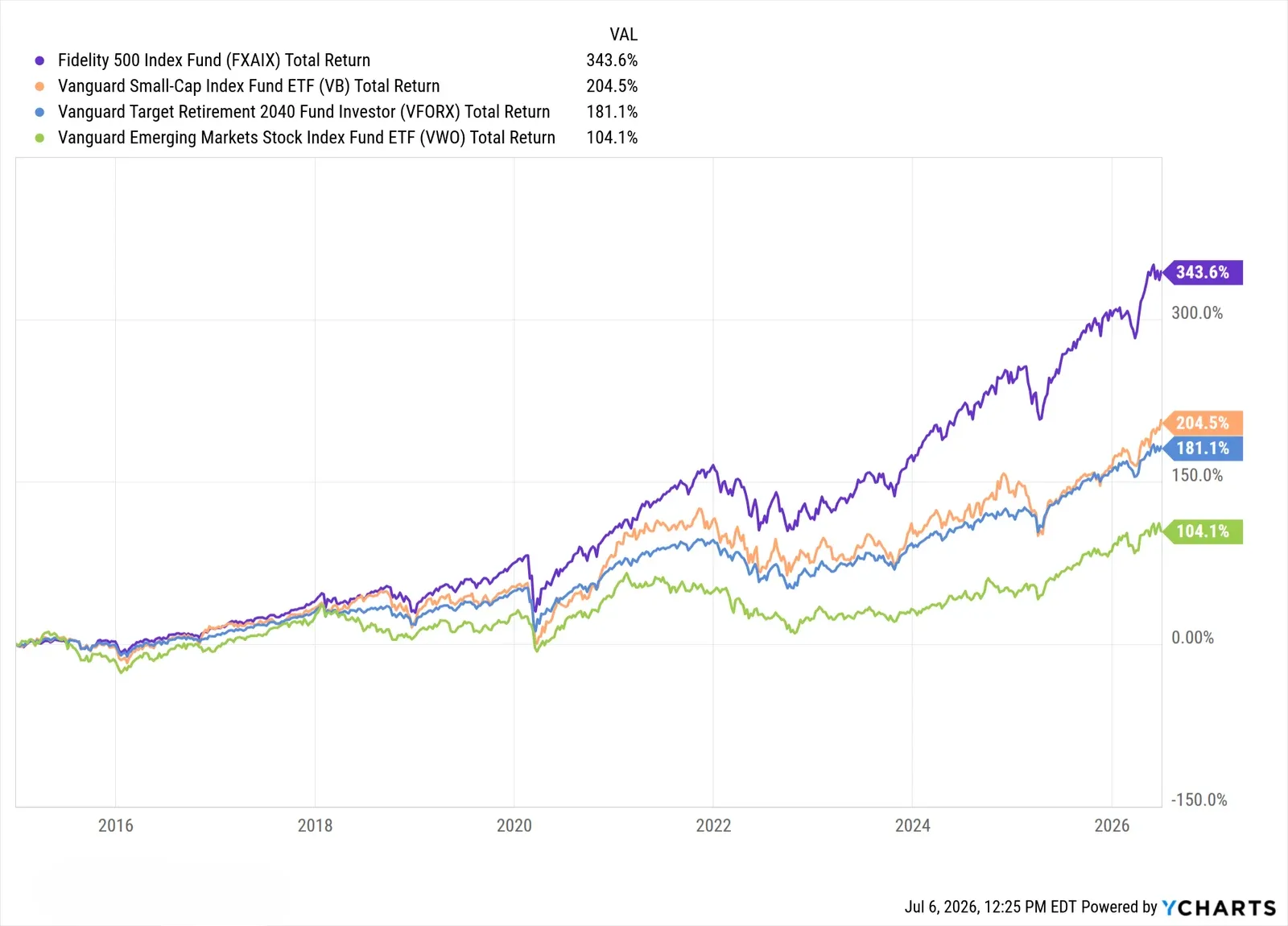
The S&P 500 is not one stock. It is 500 companies across every sector of the economy. More importantly, diversification is a portfolio-level decision, not something every account has to solve by itself.
Your 401(k) is one account. You may also have an IRA, HSA, taxable brokerage account, or spouse’s retirement plan. Those accounts can hold assets your 401(k) cannot. The 401(k)‘s job is not to own everything. Its job is to be the best growth engine the menu allows.
I mapped out which account should carry what, and why a limited menu changes your other accounts rather than this one, in Your 401(k) Portfolio.
S&P 500 companies are U.S.-listed, but most are global businesses. Recent S&P 500 summaries commonly show a rough 59/41 revenue split between U.S. sales and non-U.S. sales. The exact number moves over time, but the conclusion is simple: owning the S&P 500 means owning a globally diversified asset.
Foreign stocks can help at times, but I do not think investors should automatically allocate to international funds inside a 401(k). International exposure still has to earn its place. The same rule applies:
What job does this fund do better than the S&P 500?
If the answer is not clear, I would not add it.
Bonds can reduce portfolio risk when they move independently from stocks. In the low-inflation world before 2020, that worked well for long stretches. When stocks fell, high-quality bonds helped cushion the portfolio.
Inflation changes that relationship. In 2022, stocks and bonds both fell, which surprised investors who thought bonds automatically meant safety. More recently, BlackRock has warned that stock and bond correlations have become more positive, making the traditional 60/40 portfolio less diversified than it used to be.
That is why I do not default to broad bond index funds inside a 401(k), or anywhere else. If you are still building wealth and more than 10 years from retirement, bonds slow the account’s main job: compounding. Near retirement, the calculation changes, which is why the table above shifts part of the portfolio toward stable value instead.
Yes, the S&P 500 has concentration risk. The largest companies have become a bigger share of the index, and that matters.
But inside a limited 401(k), I still prefer that risk over the usual alternatives: high-fee active funds, small-cap drag, target-date fund bloat, and international funds that do not diversify as much as investors expect.
That does not mean every retirement dollar should go into a plain S&P 500 index fund. An HSA, IRA, Roth IRA, taxable brokerage account, or Gold+ portfolio should be structured differently because those accounts offer more options and control. The 401(k) does not.
Optimize each account for the job it can do best with the options available.
A total stock market fund sounds like the obvious answer. Own the whole market. Let small companies grow into big companies. Capture everything.
The problem is that total market index funds include small caps, and the public small-cap market has structurally changed. Many high-quality growth companies stay private longer. What remains in small-cap indexes is a larger concentration of unprofitable, debt-dependent, lower-quality companies than investors expect.
That is the problem I covered in Dead Weight: Zombies in Your Portfolio.
A total stock market fund can be a backup plan, but if you have a S&P 500 index fund available, stick with that.
Because most active stock funds fail to beat the S&P 500 after fees. End of story.
The SPIVA scorecards from S&P Dow Jones Indices have repeatedly shown that most active large-cap U.S. equity funds underperform the S&P 500 over long periods. Fees make the hurdle even worse.
Using 2024 averages, an actively managed equity fund costs about 0.64% per year. A Fidelity 500 Index Fund costs about 0.015%. That creates a 0.625% annual headwind before the active manager has done anything useful.
That sounds tiny, but it compounds.
On a $100,000 starting balance earning a 10% gross annual return for 20 years, the active fund would end around $598,646. The S&P 500 index fund would end around $670,918.
Difference:
$72,272
That is more than the average salary in the U.S.
And that assumes the active fund earned the same return before fees. Most do not.
Target-date funds are built to be one-size-fits-most retirement portfolios. That sounds convenient, but they just hold lots of assets you don’t need. They commonly hold U.S. stocks, international stocks, emerging markets, small caps, bonds, cash, and other assets.
For a wealth-building investor, that can turn a growth account into a boat anchor.
The problem is not that target-date funds are complicated. The problem is that they often own assets your 401(k) does not need for its main job: compounding.
The result is that you may have to work years longer to make up for the investment drag. In my S&P 500 vs. target-date fund comparison, the target-date funds required 4.5 to 5.6 additional years to reach $1 million.
Be very careful with company stock inside a 401(k). It can tie your paycheck and retirement savings to the same company. If the business gets into trouble, you can lose your job and retirement money at the same time.
I have seen people learn that lesson the hard way. One word: Enron.
Some 401(k) plans offer a brokerage window. Fidelity calls it BrokerageLink.
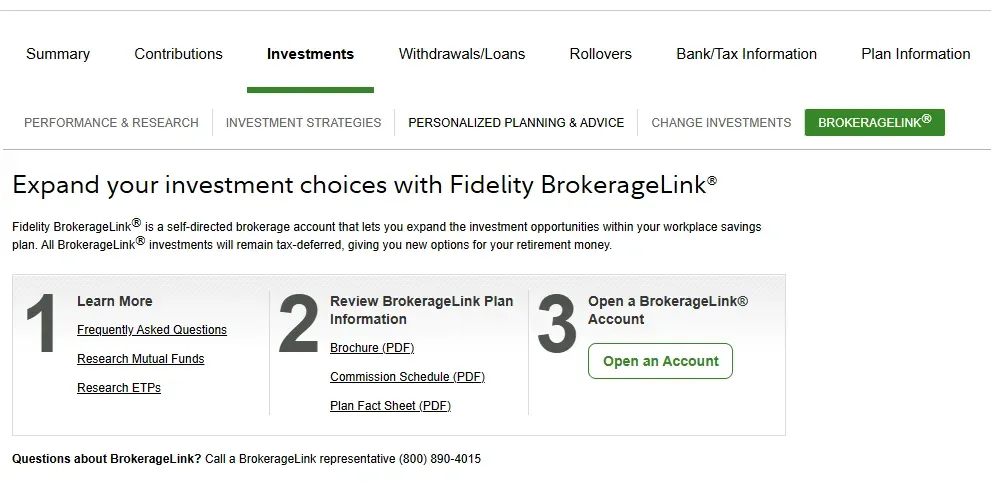
A brokerage window lets you invest some or all of your 401(k) assets outside the plan’s standard fund menu. Depending on the plan, you may be able to buy ETFs, mutual funds, or other investments that are not available in the regular 401(k) lineup.
This is not a taxable event. The money stays inside the 401(k). The account remains tax-deferred or Roth, depending on your contributions.
But more choices only help if they make the portfolio better without making it harder to manage. Before using a brokerage window, ask HR or your plan sponsor:
A small annual fee may be fine. Major transaction fees are not. The automation question matters most. If every paycheck contribution requires manual investment, you have given yourself a new job every two weeks.
That is a bad system.
If your plan offers a brokerage window, it may be a way to implement a more complete portfolio instead of being limited to the standard 401(k) menu. That only helps if the portfolio is optimized, low-cost, and easy to maintain.
This is where the Accumulation and Glidepath portfolio frameworks can help. The goal is a better wealth-building map.
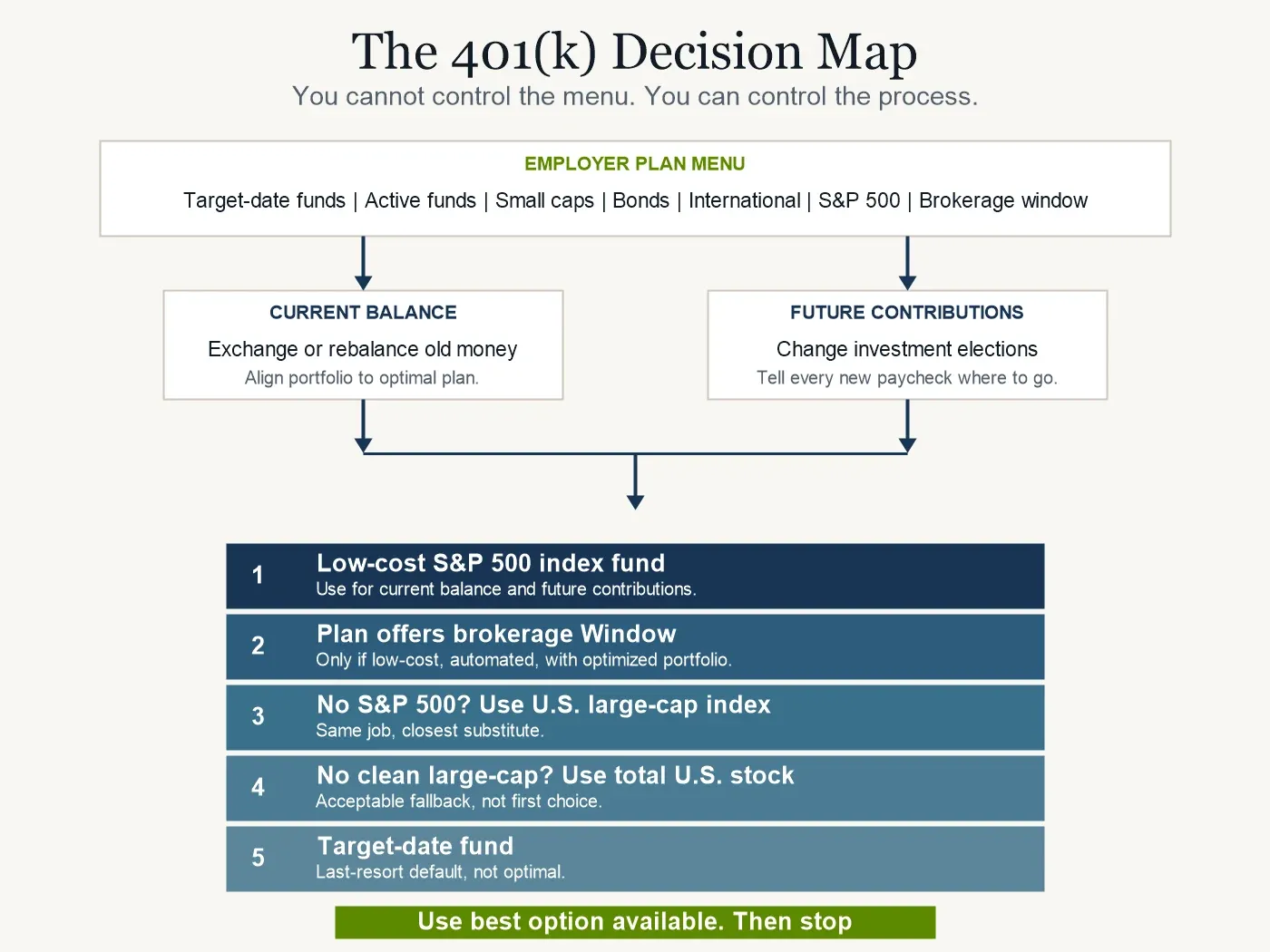
Use this as your 401(k) decision filter. Start at the top, take the first option that applies, then stop.
You do not need perfect options. You need a process.
If you cannot identify the right fund from the menu, call HR or the plan provider. Do not ask, “What should I invest in?” Ask specific questions that help you match the plan options to the decision filter.
Ask:
Ask precise questions. Get precise answers.
Log in to your 401(k). Check whether the plan offers a brokerage window, then review the standard investment menu.
Then:
Make sure every dollar in the account has the right job.
Once the account is set, the next question is whether the balance you are building actually gets you there. That is a different tool for a different job, and I compared the ones worth using in the best retirement calculator.
Nobody is watching your 401(k), least of all the target-date fund inside it.
Gold+ connects your plan, portfolio, and protection in one system. See whether you’re behind, on track, or ahead, follow the Refined FI portfolio built for your stage, and get an email when market risk calls for a change.
Prefer to see it first? Watch the 2-minute look inside Gold+.
For most people more than 10 years from retirement, one fund: a low-cost S&P 500 index fund. Inside 10 years, 70% stays there and 30% moves to a stable value fund. Everything else on the list is usually excess. Find the right one by scanning for the words index, 500, or large cap blend, then checking which candidate has the lowest fee.
If the 401(k) is from a former employer, do not cash it out. A direct rollover into a Rollover IRA at your brokerage is the cleanest option. The money stays inside a retirement account, avoids a taxable event, and gives you maximum investment control. Cashing out can create taxes and, if you are under 591/2, may trigger an additional 10% early distribution penalty.
If you are more than 10 years from retirement and still building wealth, my default answer is a low-cost S&P 500 index fund. If your plan offers a low-cost, automated brokerage window tied to an optimized portfolio, that is a better option.
That is rare nowadays, but it does happen. Use a large cap fund, a US large cap fund. Next up would be a total stock market index fund. That’ll get you close. If you cannot identify one, call HR or the plan provider and ask which fund most closely tracks the S&P 500.
Capture the employer match first. Then use the decision filter above to find the least bad option inside the plan. If the menu is truly weak, compare additional contributions against an HSA, IRA, Roth IRA, taxable brokerage account, or spouse’s retirement plan. If the plan is a 403(b), the menu problem is usually worse and has a legal reason; I covered what to hold in a 403(b) and the one fee to ask about.
I do not think they are optimal for wealth-building investors. Target-date funds often own too many assets your 401(k) does not need for its main job: compounding.
Be very careful. Company stock can tie your paycheck and retirement savings to the same business. If the company gets into trouble, you can lose your job and retirement money at the same time.
This article is for educational and informational purposes only and does not constitute investment advice, financial advice, tax advice, legal advice, or a recommendation to buy, sell, or hold any security. Refined FI is not a registered investment advisor. Past performance does not guarantee future results. All investing involves risk, including possible loss of principal. Fund fees, plan options, and contribution limits can change. Verify current plan documents and consult a qualified professional for personal advice.
A little of everything is not a portfolio. Here is the 401(k) allocation by stage, and what belongs elsewhere.
19 min read
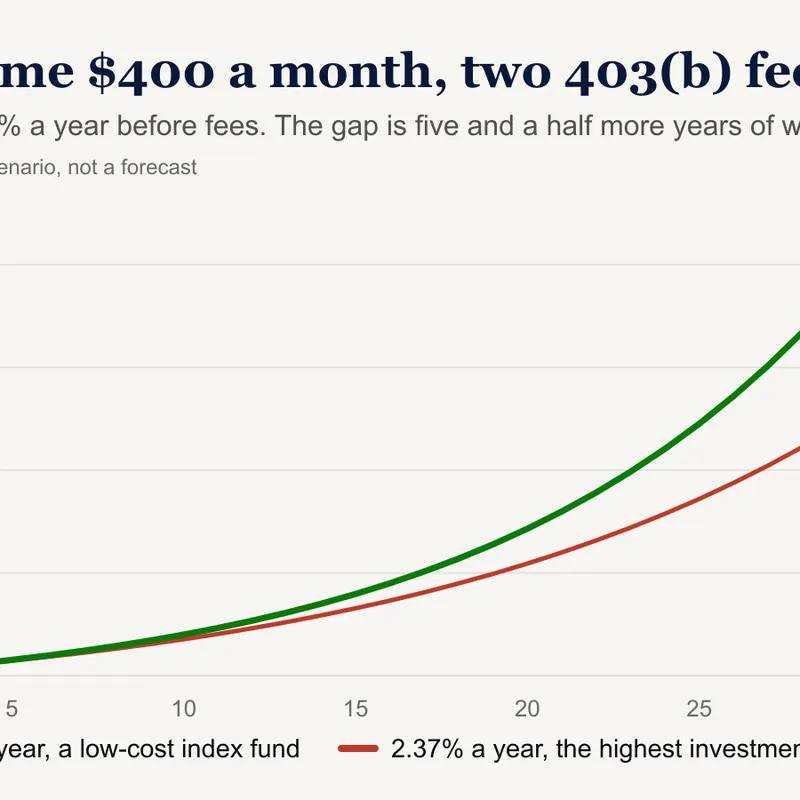
I used to sell 403(b) annuities to teachers, but not anymore. What I learned to do and what NOT to do could save you years off your retirement date.
20 min read

Two people can save the same money and end up with the same portfolio balance. One retires at 52. One has to wait until 59½. The only difference is which account the money went into.
23 min read