
403(b) Retirement Plan: How One Fee Can Add 5½ Years of Additional Work
I used to sell 403(b) annuities to teachers, but not anymore. What I learned to do and what NOT to do could save you years off your retirement date.
20 min read
Key takeaways
You build spreadsheets. You try online calculators. You enter your age, savings, income, and retirement date. Then the screen gives you a number you don’t like.
So you make a few adjustments.
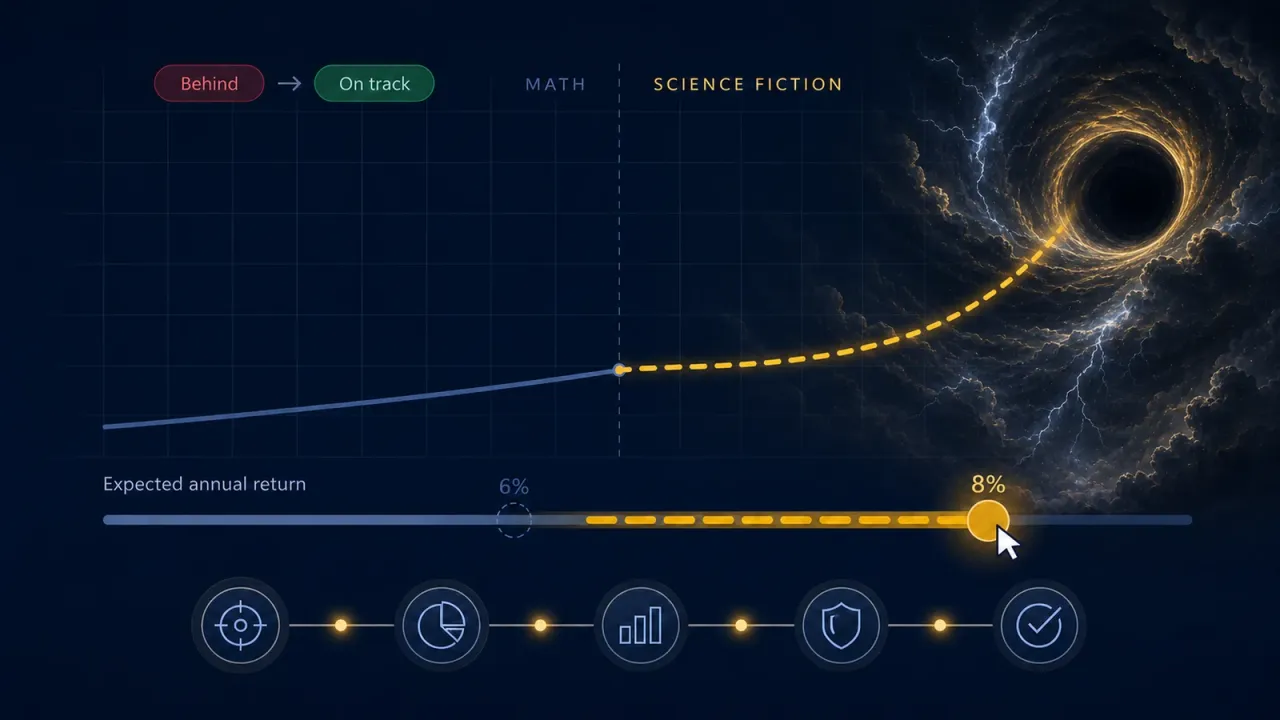
Maybe stocks return 8% instead of 6%. Maybe inflation runs at 2% instead of 3%. A few clicks later, you’re ahead of plan. Nothing in your life changed. It’s a seductive illusion, but a comfortable number isn’t necessarily a trustworthy one.
A poorly designed calculator can perform its programmed math correctly while simultaneously helping you lie to yourself.
The best retirement calculator should do more than produce a target, score, or probability. It should answer one defined question, explain what the result means, and point to the next decision you control.
That is why I do not think one calculator can solve retirement planning. Retirement is not one math problem. It is a sequence of decisions that have outcomes. Each outcome produces new information, which requires a new decision.
The Loop: information → decision → outcome → information
I do not want to pretend every other retirement calculator is a primitive spreadsheet with a prettier logo. Several major tools are sophisticated and useful.
Fidelity uses detailed household information, estimated taxes, retirement expenses, income sources, contributions, asset allocation, and Monte Carlo analysis. Its published methodology is unusually thorough. Fidelity reported in 2026 that it was replacing its Retirement Score with a broader Probability of Success measure.
Empower can aggregate financial accounts, run Monte Carlo scenarios, and model major events such as a home purchase or Social Security timing. Empower also tells users that retirement planning is ongoing, not a one-time calculation.
Boldin goes further into planning software. It includes tax modeling, Roth conversion analysis, and customizable withdrawal ordering. That matters because account sequence can change lifetime taxes and how long savings last.
Schwab connects its retirement calculator to a broader retirement hub covering savings, investing, income, tax-smart withdrawals, and regular plan updates.
These are huge firms run by smart people. I built Refined FI not to replace what they do well, but to answer the questions they still don’t address.
The comparison is about workflow. Comprehensive software can model dozens of variables, but more outputs do not automatically make the next action obvious. Refined FI uses a more precise map: one focused tool for each job and a clear next action after each result.
Some retirement questions are known unknowns.
For example:
How much do I need to retire? And how do I figure that number out?
Those questions are visible. You can search for a calculator and get an answer.
The more expensive problems are often unknown unknowns. Those are questions you do not yet know to ask, or options available to you that fall outside your expertise.
For example:
Those decisions rarely appear in the first retirement number. But they can determine how quickly you reach the number, how much you can spend, and how much of the portfolio goes to taxes.
This is the five-tool framework I built for Refined FI.
| Stage | Question | Tool | The next action |
|---|---|---|---|
| Before retirement | How much do I need, and am I on track? | Retirement Number Calculator | Tells you to keep the current pace or change savings, spending, or retirement age |
| Before retirement | Where should my next dollar go? | Contribution Waterfall Calculator | Fund available accounts in a ranked, tax-optimized order |
| In retirement | How much monthly income can my portfolio support? | Retirement Income Calculator | Use interactive sliders to adjust your spending or plan duration |
| In retirement | Which accounts should fund spending first? | Withdrawal Waterfall Calculator | Follow a current-year, tax-aware withdrawal sequence |
| Both stages | What happens in a terrible market? | Portfolio Stress Test | Does your portfolio survive the worst events of the last 100 years? |
They operate independently, but their outputs write the playbook for your next move.
Before retirement, find your destination and then optimize your route. In retirement, test the spending you need, then optimize the cash flow that supports it. If you are working out that spending as a couple, start with your own monthly number rather than a national average. Stress testing sits across both stages because a plan that only works in average conditions is fragile.
I have met clients who did not know whether their portfolio could support the income they needed. I have also worked with sophisticated investors who built their own spreadsheets to compare portfolios and test whether their standard of living was sustainable.
Both groups can miss the same thing: a single number is not a system.
Some people call it their retirement target. Others call it their FU number. Either way, you need to know your destination. If you know where you are and can calculate where you want to go, you get the key information: are you on track?
That result leads you to the next action.
The answers tell you which lever to test next.
The Loop: information → decision → outcome → information
I built the Contribution Waterfall Calculator because knowing how much to save does not answer the next question: where should your next dollar go? Laws change, and employer benefits vary widely from firm to firm.
A self-directed investor might contribute to a Roth IRA because it is familiar, skip a traditional 401(k) because there is no employer match, and treat an HSA as a medical spending account. I have watched these small account decisions repeat year after year. The cost is not a dramatic blowup. It’s a longer, meandering path to the retirement you want.
Here is a simplified example adapted from my HSA vs. Roth IRA vs. 401(k) comparison.
Assume a worker is in a 22% federal bracket and 5% state bracket, and the state follows the federal treatment used in this example. An eligible HSA contribution runs through a Section 125 cafeteria plan, and the full 7.65% Social Security and Medicare tax savings apply.
| Same $1,000 reduction in take-home pay | Approximate amount invested | Why |
|---|---|---|
| Payroll-funded HSA | $1,531 | Federal, state, and payroll taxes may be avoided through a payroll contribution; California and New Jersey are exceptions |
| Traditional 401(k) | $1,370 | Federal and state income taxes are deferred; payroll tax still applies |
| Roth IRA | $1,000 | The contribution is made with after-tax dollars |
This is not a universal account ranking. Capture an employer match first. HSA eligibility, state treatment, wage levels, plan rules, and future tax treatment matter. California does not follow the normal federal HSA treatment at the state level, and other state rules can differ. Calculators need to remain current.
The example makes the household tradeoff visible: the same 1,531 into a payroll-funded HSA, about 1,000 into a Roth IRA under these assumptions. That is 53.1% more invested from the same reduction in take-home pay. How could that change your retirement date? That is why contribution order deserves its own calculator.
The Contribution Waterfall Calculator evaluates the accounts available to you and produces a ranked funding sequence. It can expose unknown unknowns, such as payroll-funded HSA savings or unused tax-advantaged space, before another year of contributions goes to the routine account by default.
Retirement reverses the cash flow. Once contributions stop, you begin asking your portfolio to support your life and not run out late in life.
That creates two different frameworks.
What does income durability mean? Picture this: you are 80, your portfolio is running thin, and you are looking for a job just to keep the lights on. That is what can happen when you trust one number to carry an entire retirement plan.
That is why I do not treat the age when your money may run out as the answer. It is one output, and I want you to see the forces that can change it: sequence of returns, spending flexibility, and portfolio risk.
I built the Retirement Income Calculator to do more than tell you when the money will run out. It gives you options that answer:
The suggestions help your plan become more resilient and less fragile. The calculator cannot predict markets, health, taxes, or lifespan. Its job is to turn the spending question into a range of options the reader can test.
I built the Withdrawal Waterfall Calculator because a safe withdrawal rate does not ensure your retirement. You can still screw things up if you don’t know which account should provide the cash first, second, and third.
A retiree may have a traditional IRA, Roth IRA, taxable brokerage account, HSA, workplace plan, and cash reserve. Pulling only the required minimum distribution from the IRA and filling the rest from whichever account is easiest is an avoidable mistake.
The current-year sequence will need to consider:
The Withdrawal Waterfall Calculator estimates a ranked current-year sequence and shows the related tax reserve and threshold warnings. It does not promise the lowest possible lifetime tax, and it is not a replacement for a CPA.
It does, however, give you a starting point to discuss with your tax professional and refine as your retirement-income needs change.
Long-run planning uses averages. Retirements are lived in sequences.
A portfolio can earn the expected average return over 30 years and still fail if the worst losses arrive while the portfolio is the largest. That is sequence-of-returns risk.
I built the free Portfolio Stress Test because averages are not how retirement is lived. It runs your portfolio through the worst market neighborhoods of the last 100 years, including 1929, the 1970s, 2000, and 2008. It does not predict the next crisis. It asks whether the plan becomes fragile when the order of returns turns hostile.
Use it before retirement to test whether the destination depends on friendly markets. Use it in retirement to test whether spending survives a bad starting year.
The baseline projection and historical stress test answer different questions. You need both views.
Many calculators ask you to choose future investment returns and inflation. Those fields look like control. They are often an invitation to manufacture confidence.
If a disappointing result improves only because you raise the return guess from 6% to 8%, your retirement did not improve. The story you told the calculator changed.
I built Refined FI’s Retirement Number and Retirement Income calculators using long-run real returns by asset class to reduce the seductive impulse to talk yourself into a dumb mistake. A real return is the return after inflation. The tools show results in today’s purchasing power and calculate a blended return from your current portfolio allocation. Not a return that you think you will get.
This does not make the result a forecast. Long-run real returns are still model assumptions. Stocks, bonds, cash, and gold can behave very differently over shorter periods. The framework simply removes one user guess and makes scenarios more consistent.
A retirement calculator earns trust when its method is clear, its limits are visible, and it helps you make a better decision today.
When I evaluate a retirement calculator, I start with seven questions. You should too:
FINRA has used independent audits to review calculator methodology, inputs, interpretive text, accuracy, and completeness. Accuracy is not only whether the math returns a correct answer. The method, explanation, and limitations matter too.
More inputs do not automatically create a better answer. More charts do not automatically create a better plan. Judge the tool by whether it helps you make the next decision without pretending uncertainty disappeared.
A single tool can be useful, but it cannot replace a retirement planning framework.
I built this system to meet you at the stage you are in. Start here:
Before retirement:
In retirement:
If you already know the question, use the matching tool. If you do not, I built the map to show you what question comes next.
You can start with the public Refined FI tools page and free Portfolio Stress Test. I built Gold+ for people who want the rest of the map, not another isolated answer.
The best calculator is the one designed for your next decision. Use a retirement-number calculator for your target, a contribution waterfall for account-funding order, a retirement-income calculator for spending durability, a withdrawal waterfall for account sequencing, and a historical stress test for bad market periods.
They use different return models, inflation assumptions, longevity, taxes, fees, spending rules, and definitions of success. Some use deterministic projections, some use Monte Carlo simulations, and some replay historical returns. Compare the job and methodology before comparing the final number.
Monte Carlo shows a range of modeled outcomes and can be useful for probability analysis. The probability still depends on the model, distributions, correlations, inputs, and definition of success. A deterministic calculator is useful for a clear baseline and side-by-side decisions. Neither predicts your future.
A contribution waterfall ranks where the next retirement dollar should go based on employer matches, account eligibility, tax treatment, contribution limits, and the accounts available to the household.
A withdrawal waterfall ranks which accounts should fund retirement spending first, next, and last while considering taxes, required distributions, Roth conversions, age rules, and income thresholds.
Review it at least annually and after a material change in income, savings, spending, retirement date, family, guaranteed income, tax law, or portfolio allocation. Rerun the tool tied to the question that changed.
A retirement number is where you stand. Gold+ is what to do next.
Start with the free Portfolio Stress Test. Gold+ connects your plan, portfolio, and protection in one system. See whether you’re behind, on track, or ahead, follow the Refined FI portfolio built for your stage, and get an email when market risk calls for a change.
Prefer to see it first? Watch the 2-minute look inside Gold+.
This article is for educational and informational purposes only and does not constitute investment, financial, tax, or legal advice. Refined FI is not a registered investment adviser. Calculator outputs depend on model assumptions and user inputs and do not guarantee future results. Tax treatment, eligibility, limits, thresholds, and plan rules can change. Confirm tax-sensitive decisions with a qualified tax professional. Refined FI receives $0 in affiliate revenue, commissions, or compensation from any calculator or financial institution mentioned in this article.
I used to sell 403(b) annuities to teachers, but not anymore. What I learned to do and what NOT to do could save you years off your retirement date.
20 min read
Understand what a retirement calculator should do and use a five-tool framework that turns each answer into your next retirement decision.
16 min read

BlackRock's BDVIX owns thousands of bonds, but retirement income diversification requires more than one income engine.
8 min read