

Your 401(k) Portfolio: One Job, One Fund, and Where the Rest Belongs
A little of everything is not a portfolio. Here is the 401(k) allocation by stage, and what belongs elsewhere.
19 min read

Key takeaways
You finally sit down with a cup of coffee, run a retirement calculator, and it hands you a verdict: you are $412,000 short. Then what? No next step, no plan to get back on track, just a number and a feeling in your stomach.
I watched people meet that moment for years, and again and again they did the same thing: closed the tab and never came back. Not because they were lazy. Because the tool left them feeling helpless. “I’m so far off track, I might as well not even plan.” A plan you abandon because of a poorly designed calculator is the only plan that truly fails.
So before you resign yourself to working years longer, I want to show you the lever almost nobody checks first.
Every retirement article hands you the same three options for closing a gap: save more, retire later, or plan to spend less. All three work. All three hurt. One takes money from your paycheck today, one adds years of working and rush-hour commutes, and one reduces your standard of living. Supermarket ramen, anyone?
There is a fourth lever, and it is the only one that costs nothing out of pocket: check whether your portfolio actually matches your retirement stage.
Most portfolios I reviewed over my career did not. They were a mishmash of random investments. A fund from your old job, a hot pick from your cousin that never panned out, a bond fund bought in the name of diversification. A little of everything is not a portfolio. It is a sail only half raised. The wind is there. The sail is there. Only part of it is pulling you forward. Aligning the portfolio means elimination: you keep the holdings doing the job your stage needs done, you cut everything that is not, and you own the right securities for your stage, nothing more and nothing less.
That cleanup pays you twice. The first payment is the one this article is about, a portfolio that finally works toward your retirement instead of against it. The second arrives later, on the day something tells you it is time to protect what you have built. If you are holding thirty scattered positions on that day, you will not know which one to touch, and you will freeze. If your portfolio is aligned to your stage, you already know.
Your stage comes from one input: years to retirement. Not your age bracket, not what a pie chart says a 50-year-old should own.
| Where you are | Your stage | The portfolio’s one job |
|---|---|---|
| 10+ years to retirement | Saving for retirement | Maximum compounding. You have time to recover, so growth does the work. |
| Inside 10 years | Retiring soon | Keep growing while adding stability, so a bad market just before retirement cannot wreck the plan. |
| Retired | Retired | Turn the portfolio into reliable income. Your spending, relative to the portfolio providing it, decides how defensive the design must be. |
Your spending against the portfolio providing it is your burn rate, and a couple works that number out in four steps. Now audit what you own against that one job. A holding that is not helping the job is not neutral. It is dead weight, and dead weight compounds against you the same way returns compound for you.
A skeptic will say that closing a gap by changing the portfolio is just cranking up the risk. It is the opposite. In the Zombies article I showed what a single piece of dead weight costs: since 2015 the small-cap index returned 189.5% while the S&P 500 returned 341.2%, and small caps fell harder in the downturns too. Cutting that one holding raised the return and lowered the risk at the same time. That is elimination.
The higher number comes from removing the drag, not from reaching for more risk. When a chunk of your portfolio holds assets that do not serve your stage, your money works against itself. Clear those holdings out, move that money into the holdings that are doing the stage’s one job, and the swap improves what the portfolio can deliver at the risk level your stage already calls for. Like sailing: trimming the sail so the wind and the sail are aligned. Same wind, same boat, same risk. You just go faster.
Your stage sets a ceiling on risk, not just a floor. If your portfolio already matches your stage, I do not recommend taking on more risk than the stage calls for just to close a funding gap. In that case the fix is the plan, not the investments.
I built the Retirement Number Calculator around this exact order of operations. When you run your number, you get more than an answer. You get options.
You are behind, and portfolio alignment alone closes the gap. The calculator shows the before and after: same savings, same retirement date, same spending, gap closed. The change happens first in tax-deferred accounts, because inside an IRA, HSA, or 401(k) selling a fund does not trigger a tax bill, so the cleanup is painless.
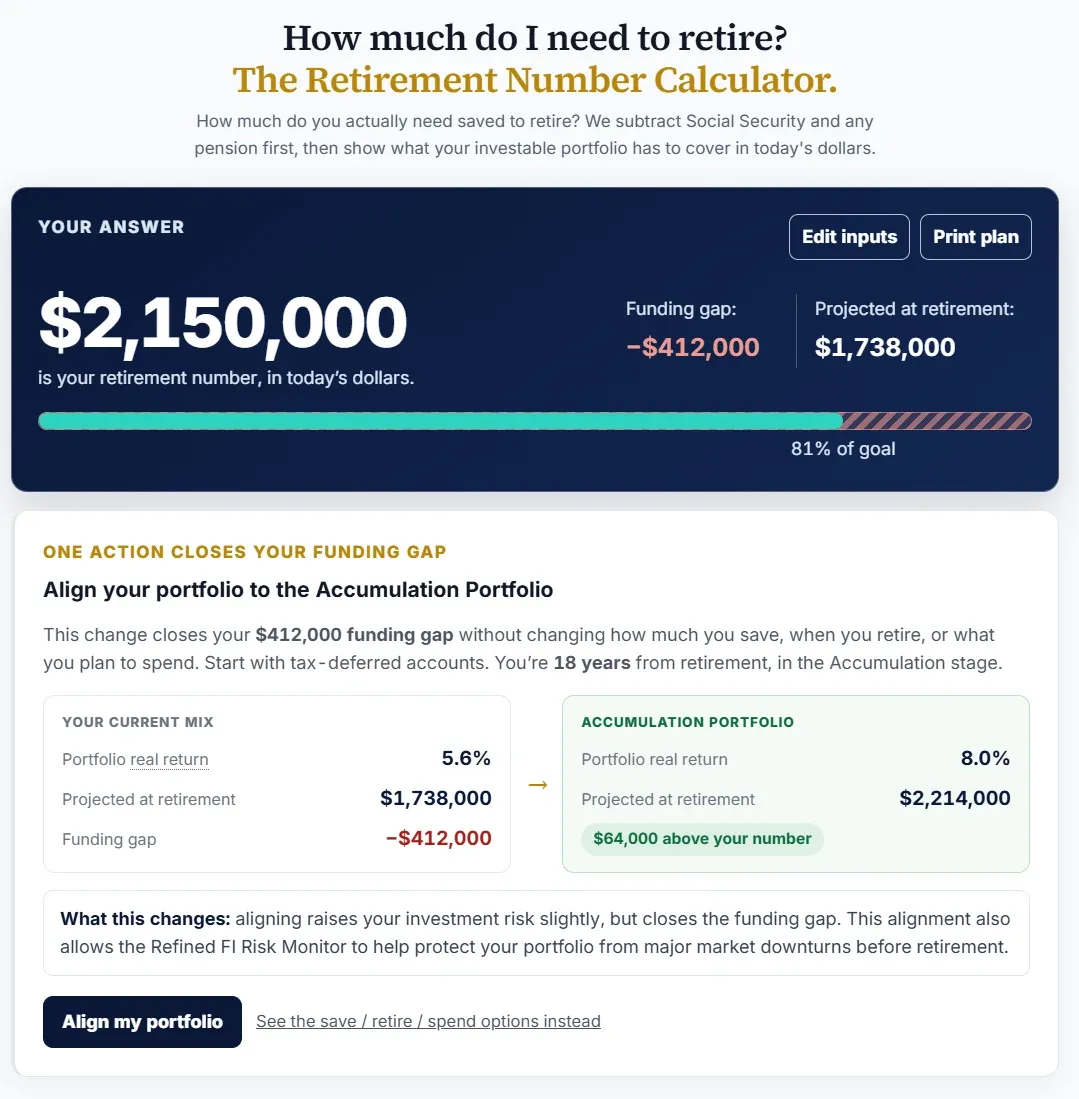
You are behind, and portfolio alignment covers part of it. The portfolio does the heavy lifting, and the calculator then asks one question: of saving a little more, retiring a bit later, or spending a little less, which is easiest for you to live with? It prices each one, and any single one finishes the job.
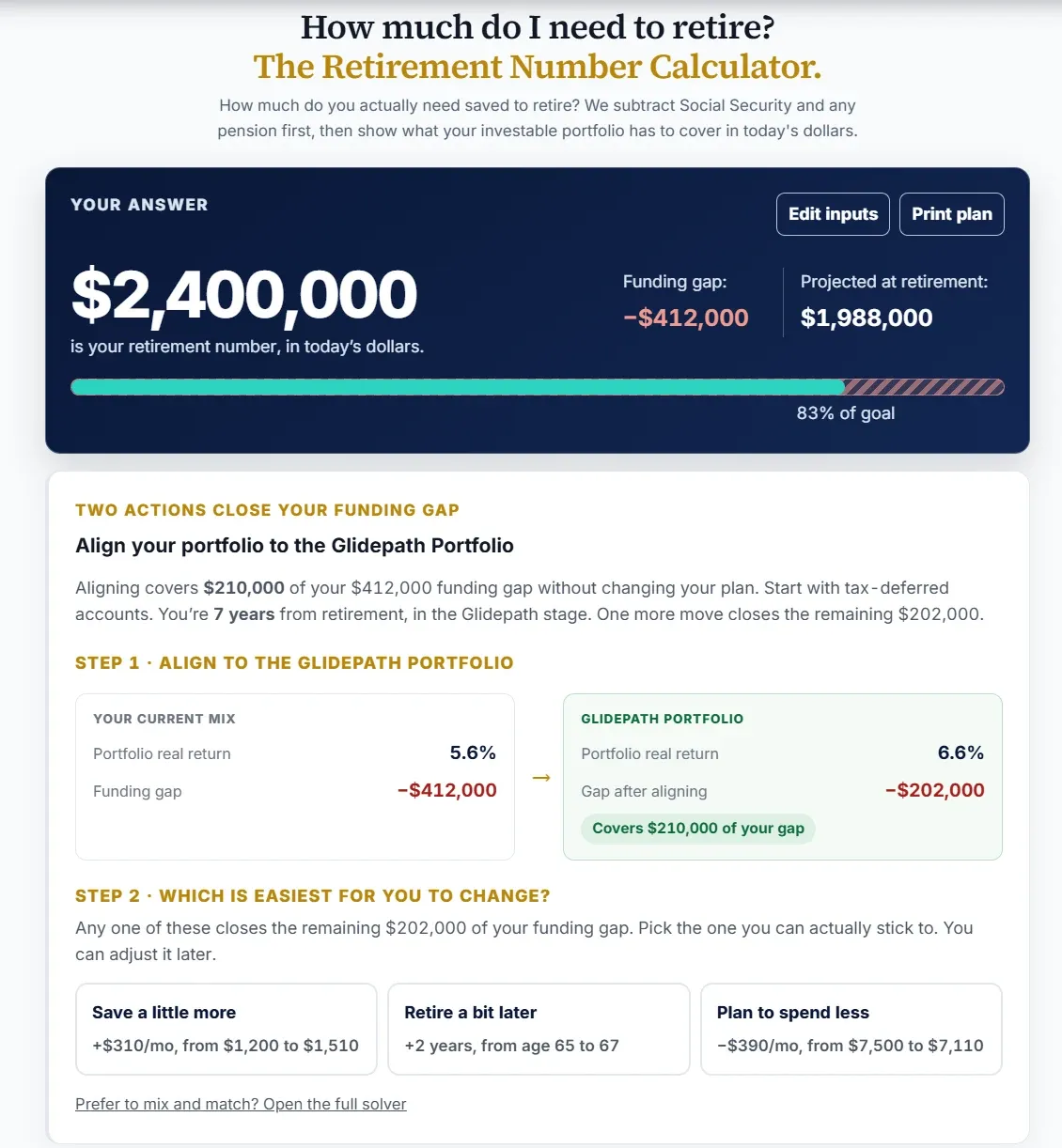
Your portfolio is already aligned, but you are still not on track. Your stage caps your risk, and you are already at the cap. So the calculator turns the question around. Instead of asking what you are willing to change, it asks what stays the same. Of saving more, retiring later, and spending less, you lock the two you will not give up, and it solves your gap with the third.

You are ahead. You do not have to change a thing. But in this example’s math, the same alignment move turns a surplus into retiring three years earlier, or into saving $480 less per month toward the same date.
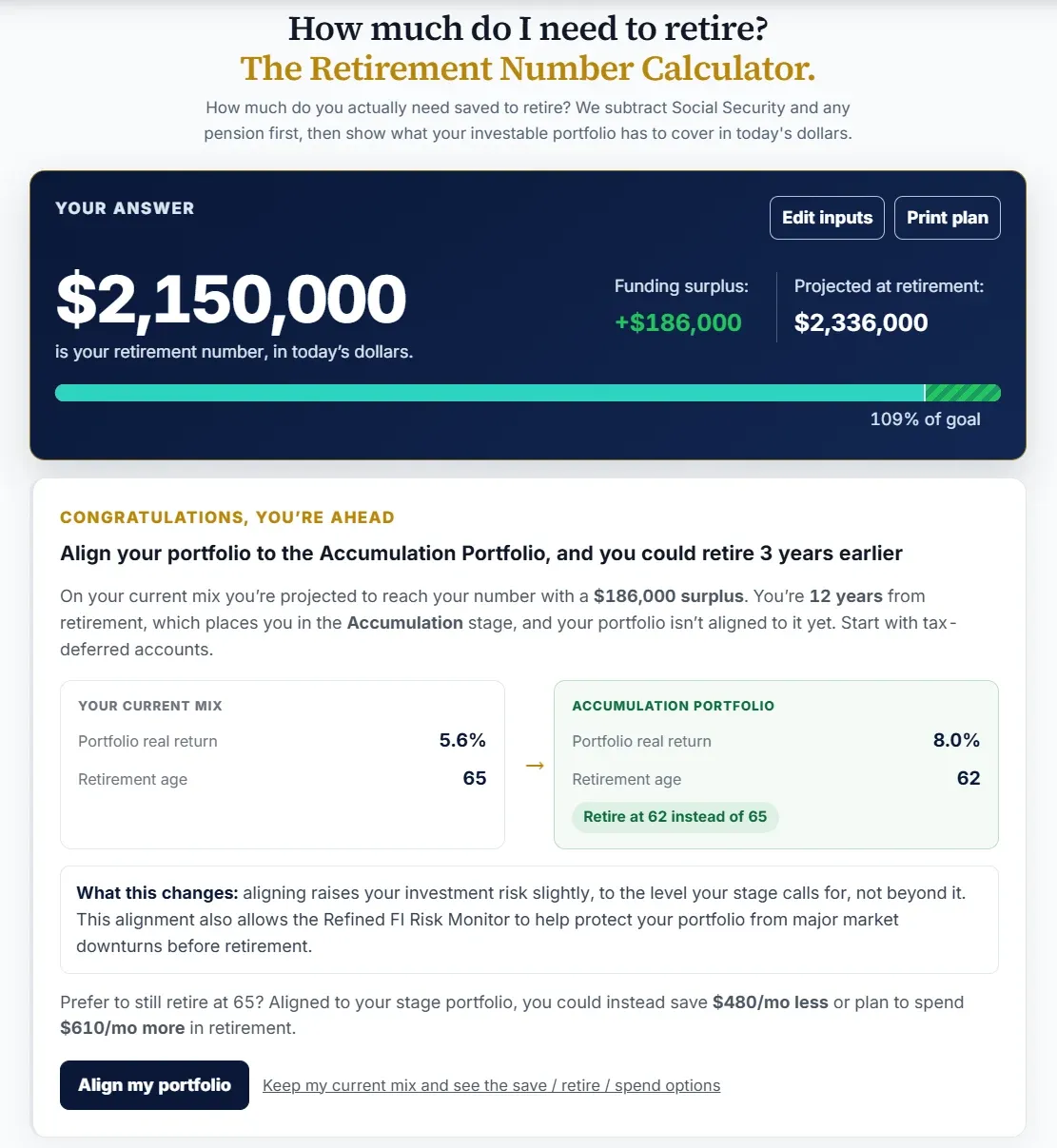
In all four situations, you are never left alone with a scary number. No matter how many detours your life has taken, there is always a route to your destination. It might take more time or more money, or both, but your next best action always exists. A calculator that does not tell you your next action is not a plan. It’s a waste of time.
You do not need a membership to use the ordering rule. Here is the whole thing:
Two free tools on this site let you practice steps 1 and 2 right now. The 401(k) Asset Allocation Calculator tells you what your current 401(k) allocation costs you, answered in years and months of extra work. The Portfolio Stress Test runs your portfolio through the worst markets of the last century and shows you which one breaks it.
That self-check becomes the guided version you saw in the screenshots. The Retirement Number Calculator answers the first question every saver asks: how do I know when I have enough? It answers that for you, but more importantly it gives you your next action.
The next question is the one almost nobody thinks to ask: am I saving in the right locations? That is what the Contribution Waterfall Calculator answers, and the answer is worth more than most people expect. The amount you budgeted to save each month is an after-tax number, because it came out of a paycheck the government already took its cut of. Route it through the right accounts and the tax you would have paid goes into the account instead.
Take a real example: a single earner making 2,000 a month of take-home pay, fill the HSA and the 401(k) to their limits first, and put what remains in a Roth IRA, and roughly 800 more of it working for you.
Two questions arrive later: how long the money lasts, and what order to spend it in. The Portfolio Longevity Calculator and the Withdrawal Waterfall Calculator answer those when you get there.
If the calculator you used left you with a number and nothing else, that gap is exactly what Gold+ was built to close: the calculators find the gap, a Refined FI portfolio matched to your stage closes what alignment can close, and the Risk Monitor checks conditions daily and emails you when guidance calls for a portfolio action. That last piece is why aligning early pays you twice. See what members get.
Pilots are off course most of the time. The jet stream shifts, a storm moves in, air traffic gets in the way, and they respond with constant small corrections that get the plane exactly where it was always going.
Your financial life works the same way. You change jobs, a new baby arrives, your kid starts college, the stock market has a tantrum. That is what I built Refined FI to do.
Check your portfolio first, because it is the cheapest correction on the whole map. Then let the plan levers handle the rest. And whatever the number says today, do not close the tab. Test and align with each life event.
The dollar figures in the screenshots and examples throughout this article are illustrations, not any member’s data. Tax figures use 2026 brackets and contribution limits and will change.
A little of everything is not a portfolio. Here is the 401(k) allocation by stage, and what belongs elsewhere.
19 min read
I used to sell 403(b) annuities to teachers, but not anymore. What I learned to do and what NOT to do could save you years off your retirement date.
20 min read

Target-date fund vs S&P 500, run on real returns. One of them took 4.5 to 5.6 years longer to get you to the same number.
13 min read