

Your 401(k) Portfolio: One Job, One Fund, and Where the Rest Belongs
A little of everything is not a portfolio. Here is the 401(k) allocation by stage, and what belongs elsewhere.
19 min read

By the end of this page you will know one thing: whether your money should go into your 457 first or second, and how many years earlier that one choice could let you retire.
Here is what this article covers.
What a 457 is, and who can have one. Why the order you contribute to your accounts decides how early you can stop working. One rule that makes that order permanent, so a choice you get wrong at 45 cannot be fixed at 52. What changes if you work for a charity instead of a government. What fund you should use to invest for this early retirement, which is the same answer in all three accounts: a low-cost S&P 500 index fund, as long as you are more than ten years from retiring. I have written that part out step by step, so this page points you there instead of repeating it.
There is an interactive tool below that helps you determine your best options.
Two people work for the same county. Same salary, same savings rate, same investment funds, same everything.
Both put away $30,000 a year from 40 to 52. At 52 they each have about $642,000.
The first one put every spare dollar into the county’s main retirement plan. At 52 she cannot spend a cent of it. Not without paying an extra 10% tax, or setting up fixed payments she is not allowed to change until she is 59½. So she keeps working.
The second one took the retirement plan match first, then filled her 457 to the annual limit, then went back to the main retirement plan. At 52 she has about $563,000 sitting in the 457, and she can spend it the day she leaves. At $60,000 a year that covers nine years, and she only needs seven and a half to reach 59½.
Neither of them saved an extra dollar. Neither picked better funds. One of them is done at 52 and the other is working until nearly 60.
There is a sequence to how you allocate your contributions, and there is a sequence to what you take out. Get the first one right in your forties and the second one is available to you in your fifties.
Where to save first
Who do you work for?
Does your job offer a 457 plan?
Your pay site may call it deferred comp instead of a 457. It is a separate account from your main retirement plan at work.
When do you want to retire, and how much do you spend each year?
A 457 is a retirement account that only two kinds of employer can offer.
A state or local government. That covers school districts, community colleges and state universities, police and fire departments, public hospitals, transit authorities, courts, city and county offices and every state agency. About 18.7 million people work somewhere on that list.
Or a nonprofit, which covers many private hospitals, charities, museums, foundations and independent schools. That kind works differently, and it gets its own section further down.
If you work for the federal government or the military you cannot have one. Your equivalent is the Thrift Savings Plan, and I have written about what to hold inside it. If you work for a private company you cannot have one either. Some companies offer something called deferred comp, which sounds similar and is a different thing entirely.
How the money goes in. You pick an amount to come out of each paycheck. It is taken out before federal and state income tax, so the amount you get taxed on goes down significanlty. Many plans also offer a Roth version, where you pay the tax now instead of later and the money comes out tax free at the end. The 2026 limit on what you can put in is $24,500, the same as a 401(k). From age 50 you are allowed to add another $8,000 on top, and between 60 and 63 that rises to $11,250, if your plan allows it. Those extra amounts are called catch-up contributions, and they come up again below.
How the money comes out. It grows with no tax bill along the way, and you pay normal income tax on whatever you take out. You can start taking money once you leave that employer, at any age. While you are still working there, a government 457 opens at 59½. The government makes you start taking money out at 73, or 75 if you were born in 1960 or later, the same as an IRA or a 401(k). Leaving the money in a 457 does not put that off.
How it compares to a 401(k). Same limit, same tax rules, same age when the government makes you start taking money out. Three things differ, and each one matters.
| 457(b) | 401(k) | |
|---|---|---|
| Your own contribution limit, 2026 | $24,500 | $24,500 |
| Extra you can add from age 50 | $8,000, government plans only | $8,000 |
| Extra you can add from 60 to 63 | $11,250 if the plan allows it | $11,250 if the plan allows it |
| Most that can go in, counting your employer’s money | $24,500 | $72,000 |
| Money your employer adds | Rare, and it comes out of your own limit | Common, and it is added on top of your limit |
| Spending it after you leave | Any age, no extra tax | No extra tax if you left at 55 or later. Otherwise an extra 10% before 59½ |
| Spending it while still working there | 59½ | 59½ |
| Who can offer it | State and local government, and charities | Almost any employer |
The rule that caps what you put into a 401(k) or a 403(b) does not mention 457 plans at all. They are counted separately.
So if your employer offers you both, you can put $24,500 into each one in the same year. That is $49,000 of pay you owe no income tax on this year, before the extra amounts people over 50 can add. Few people can spare that much out of their pay, and the ones who can usually have a second income in the house.
Know it anyway, because your limit is not what stops you. Your paycheck is.
Usually, yes. Most states start from your federal number, so money you put in a 457 is money your state does not tax either. The saving is your state rate on top of your federal one.
Three places work differently.
Nine states have no income tax, so there is nothing to save: Alaska, Florida, Nevada, New Hampshire, South Dakota, Tennessee, Texas, Washington and Wyoming.
Pennsylvania taxes the money going in and not coming out. Your contribution counts as Pennsylvania wages the year you make it, so you get no state saving now. Pennsylvania then does not tax a cent of the withdrawal once you are 59½.
New Jersey taxes a 457 contribution but not a 401(k) one, and that changes this whole decision if you live there. Since 1984 New Jersey has let people leave 401(k) money out of their state wages, and it has never done the same for a 403(b) or a 457. You get some of it back later, because only the growth is taxed when you take the money out. The saving up front is not there.
Everywhere else, ask your payroll office one question: does my 457 contribution come out of my state wages as well as my federal ones? They will know.
The biggest benefit of a government 457 is simple. After you leave your job, you can take money out at any age without paying the extra 10% tax. You still pay normal income tax.
But a 457 does not always give you as many extra years as it first appears. These three rules decide how much it helps.
1. Your 401(k) may be available at 55.
If you leave your job during or after the year you turn 55, you can take money from that job’s 401(k) without paying the extra 10% tax.
The rule only covers the plan at the job you just left. It does not cover an IRA or a 401(k) from an older job. You may be able to move an old 401(k) into your current plan before you leave.
Ask your plan two questions before you count on this: Can I move an old plan into this one? Can I take out small amounts after I leave? Some plans only allow one large payment, which can create a large income-tax bill.
2. Some public safety workers can use their main plan at 50.
If you work in police, fire, emergency medical services, or corrections, you may be able to take money out at age 50 or after 25 years of service, whichever comes first. If this rule covers you, the 457 gives you fewer extra years.
3. Money moved into a 457 keeps its old rules.
This is the rule most likely to cost you money. If you move money from a 401(k), 403(b), or IRA into your 457, that money can still face the extra 10% tax when taken out before age 59½.
The 457 rule covers money that started in the 457, along with the growth on that money. If you put everything into your 401(k) at 45, moving it into your 457 at 52 will not remove the extra tax.
If your money is already in a 401(k)
If you are 52 and want to stop working, you may have one other choice. Tax rules let you take scheduled payments without paying the extra 10% tax. But once the payments start, you must follow the schedule until age 59½. If you stop or change the payments too soon, the extra tax can apply to every payment you already took.
Saving in the 457 first avoids those strict payment rules.
This rule catches people who move from a private company to a government job.
In a 401(k), everything can add up to $72,000 in 2026. Your $24,500 goes in, and your employer’s match sits on top of it.
In a 457, $24,500 is the cap on everything put together. If your employer puts in $3,000, the most you can add drops to $21,500. Their money does not give you anything extra. It only changes who paid for it.
This is a large part of why you take the match first. In a 401(k) it is free money on top of your own limit. In a 457 it is money taken out of your limit. So a match is a reason to use a 401(k), and never a reason to use a 457.
What you buy inside a 457 is the same answer as a 403(b) and a 401(k). In all three, what you hold is what decides how soon you can stop working.
| Years to retirement | The job | What to hold |
|---|---|---|
| More than 10 years | Build wealth | 100% S&P 500 index fund |
| Less than 10 years | Protect what you built | 70% S&P 500 index fund, 30% stable value fund |
Go down this list and take the first option your plan has.
Inside 10 years of retiring, 30% moves to a stable value fund. Your plan may call it a fixed account or a guaranteed interest account instead. Take whichever one pays the highest interest and does not charge you a fee to get out. If your plan has none of them, use a short-term bond fund rather than a broad bond index fund, and 2022 is why.
Change both settings, not one. Most plans keep the balance you already have separate from where future contributions go, so changing one leaves the other exactly where it was. The screens work the same way as a 401(k).
Some plans let you out of the limited plan menu entirely. Ask whether yours offers a self-directed brokerage account. It goes by that name or by the provider’s name for it, and where it exists it turns your 457 from a short fund list into an open account that can hold individual funds and exchange-traded funds. The State of Florida’s plan for government employees offers one through Charles Schwab. The City and County of Denver’s plan has one. The New York State plan defines the term in its own glossary. Most plans do not have one, and the only way to find out is to ask your plan administrator.
Where your plan has one, you stop picking the best of five options and can hold a properly built portfolio like the Refined FI Accumulation Portfolio instead.
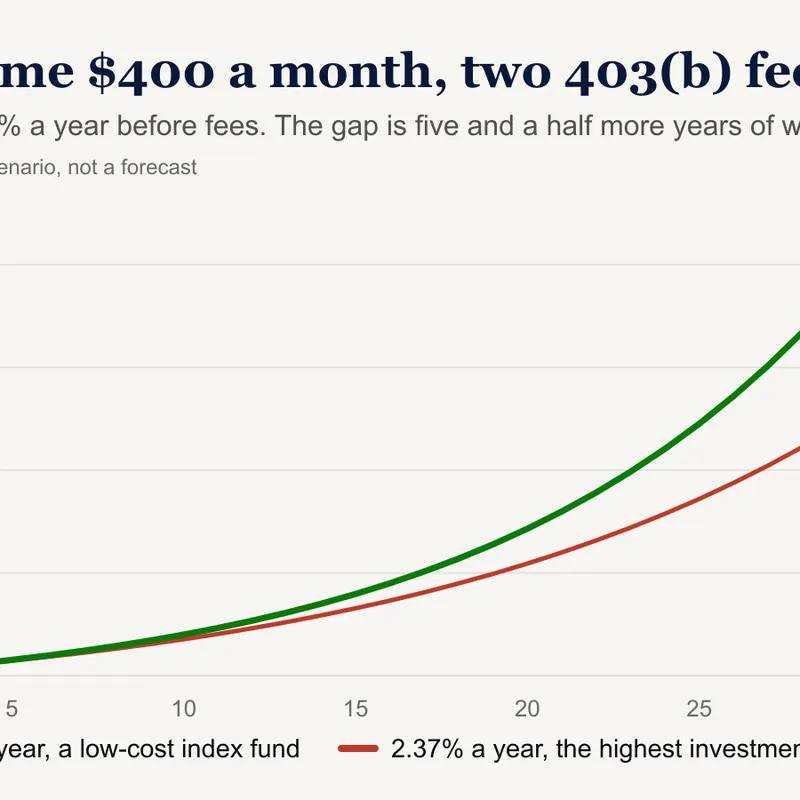
Many government 457 plans are cheap. Some are not. School district plans in particular can be full of insurance company products whose fees you only find if you ask for them by name. In its 2022 study of 403(b) plans, which are sold by the same companies and sit beside these accounts in the same districts, the Government Accountability Office found yearly fees ranging from 0.01% to 2.37%.
So what happens when your 457 charges 2% a year and your main plan has an index fund charging almost nothing? Is being able to reach the money early still worth it?
Both the fee and the early access can be counted in years. Say you save $1,000 a month for twelve years, from 40 to 52, and the market returns 10% a year before fees come out.
| Yearly fee in this example | What you would have after 12 years | Years to reach $275,658 |
|---|---|---|
| 0.04% | $275,658 | 12.0 |
| 2.00% | $240,508 | 13.1 |
The 2% fee definitely eats into your savings. You end up $35,149 short, and closing that gap takes about one more year of work.
Now the other side of that trade. The money in your 457 is what lets you stop at 52 instead of 59½, which is up to 7½ years of not working.
One more year of work is the price. Up to seven and a half years is what it buys. If stopping early is what you are after, pay it. If what you want is the biggest possible balance at a normal retirement age, put the money in the cheap index fund in your main plan instead.
Sometimes there’s a black and white answer, and sometimes there’s a gray one. This one, it’s a little foggy, and your own numbers decide it. Work out what your own fund choice costs you in years, then hold it up against the years your 457 would cover. Two numbers, both in years, and the decision makes itself.
Everything above assumes your employer is a government. If it is a charity, a private hospital, a museum or an independent school, your 457 is a different account wearing the same name. Start with what happens if the organization fails.
The money is not yours until they hand it to you. By law this kind of plan is not allowed to hold your money separately from the employer’s own. Your balance is legally your employer’s property and their promise to pay you one day. If the place goes under, everyone it owes money to gets paid before you do. The IRS says this in as many words.
The same structure, an unfunded promise from an employer, caught bank staff in 2023. After First Republic failed that May, former employees sued the government in December, saying payments under their deferred compensation plan had stopped.
It is only open to senior staff. The law limits these plans to a small group of managers or high earners. If you are an ordinary nurse or teacher at a private institution, you may not be allowed in at all.
Three more limits. You get no extra amount at 50, because that is government plans only. You cannot borrow from it. And when you leave you cannot move it to an IRA, only to another nonprofit employer’s 457, which in practice means the money comes out and gets taxed. While you are still working there it also stays shut until 70½, rather than the 59½ a government plan gives you.
So judge the institution before you fill it. How long has it been around? Does it have a real reputation in the community? A new charter school with no history is one I would be reluctant to put money into. A public school district or a government agency is one I would feel comfortable with. There is no scoring system for that judgment, and most employees have no good way to run it. So take the match and fill the main plan first, and let the charity 457 be the last account you fund rather than the second.
If you work for a private company, you cannot have a 457 at all. What your employer offers is deferred compensation, which is a promise to pay you later rather than an account with your name on it. If the company goes under, everyone it owes money to gets paid before you do. It has its own trap as well. You have to pick the year you get paid long in advance, and you cannot change your mind later. Getting that wrong costs 20% of the money plus interest, on top of normal income tax. It is a real tool for a high earner, and it answers a different question from the one on this page.
Once you are 50, a government 457 lets you add $8,000 on top of the $24,500. Between 60 and 63 that becomes $11,250 instead, if your plan has adopted it.
There is also an extra allowance that only 457 plans have. In the three years before the retirement age your plan sets, you may be able to put in double the limit, $49,000 in 2026. Two conditions cut it down. It only covers what you were allowed to put in during earlier years and did not, so somebody who always put in the maximum gets nothing from it. And you cannot use it in the same year as the age 50 amount, so you take whichever is bigger.
Now the rule that can leave you at zero. From this year, if you earned more than $150,000 last year from the employer running your plan, those extra amounts have to go in as Roth, meaning you pay the tax now. If your plan does not offer a Roth option at all, the extra amount you are allowed drops to $0. Not to a smaller number. To nothing. If you are over 50 and over that income line, ask your plan whether it has a Roth option, this month.
One carve-out that a lot of public employees qualify for. That income test is measured in Social Security wages, and many state and local jobs sit outside Social Security with a pension instead. Look at your pay stub. No Social Security tax withheld means no Social Security wages, which means the Roth catch-up requirement does not reach you, whatever you earn. The detailed rules start in 2027 and later still for most government plans, so ask your plan how it is handling 2026.
The order you fill these accounts decides when you can stop working. The order you empty them decides how much of it you keep, because drawing from the wrong one first hands money to the government that you were never required to pay. Gold+ includes the Withdrawal Waterfall Calculator, which works out which account to take money from first once you have more than one, and the portfolios that go inside them.
Neither is better on its own. A 401(k) usually has an employer match, which is free money, so it gets your first dollars. A 457 lets you spend the money at any age once you leave the job, so it gets your next ones. If you have both, take the match in the 401(k) and then fill the 457.
Employer contributions come out of your own limit rather than adding to it, matches are uncommon, and the fund menu is often smaller than a 401(k)‘s. If your employer is a charity rather than a government, the money is legally your employer’s until they hand it over, and everyone they owe money to would get paid before you. You may not be allowed in unless you are senior staff, and you cannot move it to an IRA.
Yes, once you have left that employer, at any age, without the extra 10% tax. You still pay normal income tax on what you take out. The exception is money you moved in from a 401(k), a 403(b) or an IRA, which keeps the extra 10% tax until you are 59½.
You can leave it where it is and spend from it at any age, move it to an IRA or another employer’s plan, or take it all at once. If you retire before 59½, leaving it in the 457 is usually the right answer, because moving it to an IRA gives away the early access you spent years building.
Yes, and to the full limit on both. The two limits are counted separately, which is unusual and is one of the strongest reasons to use a 457 if you have the income to fill it.
No. Only state and local employers, and charities, can offer one, so no federal job has a 457. Federal workers and the military have the Thrift Savings Plan instead. You can use it without the extra 10% tax if you leave federal service in or after the year you turn 55.
Usually no. Most plans give you a fixed list of funds. Some offer a self-directed brokerage account, which opens the account up to a much wider range of funds and exchange-traded funds. Ask your plan administrator whether yours has one, because it is rarely advertised.
If your employer is a state or local government, the money is held in trust for you and is protected. If your employer is a charity or another nonprofit, it is not. The balance is the employer’s property, and everyone it owes money to gets paid before you do.
A little of everything is not a portfolio. Here is the 401(k) allocation by stage, and what belongs elsewhere.
19 min read
I used to sell 403(b) annuities to teachers, but not anymore. What I learned to do and what NOT to do could save you years off your retirement date.
20 min read

Two people can save the same money and end up with the same portfolio balance. One retires at 52. One has to wait until 59½. The only difference is which account the money went into.
23 min read