

Your 401(k) Portfolio: One Job, One Fund, and Where the Rest Belongs
A little of everything is not a portfolio. Here is the 401(k) allocation by stage, and what belongs elsewhere.
19 min read

Fidelity BrokerageLink is an option inside your 401(k) that lets you buy ETFs that your plan’s limited menu doesn’t carry. It’s one of those benefits that’s an unknown to most people.
Is Fidelity BrokerageLink worth the effort? While you’re saving for retirement, only if you have a portfolio that’s been statistically tested to beat the S&P 500 over a long period, and your plan lets about 15% or more of your contributions go there.
My wife’s 401(k) was in an S&P 500 index fund, which is already a really good spot. I moved part of it into BrokerageLink anyway. I’ve spent two decades researching portfolios for a living, and I know the portfolio I built for my clients does better than the S&P 500 on average. It won’t win every year. Nobody bats a thousand. But over the long term it wins, and every percentage point it adds shaves time off our retirement date.
If you’re saving for retirement and don’t have a portfolio like that, stay in your S&P 500 index fund. Keep it easy. Opening BrokerageLink to buy a few funds that beat the S&P 500 the last year could drag your returns backward and makes your 401(k) more complicated than it needs to be. Only do this with a tested system.
The S&P 500 is a process, and the process is why it beats a lot of other funds.
A company has to earn its way in. A committee decides who gets added, and a company has to be profitable before it gets access to the club. S&P checks its latest quarter and its last four quarters added together. A company could be one of the 500 biggest in the country. If it isn’t making money, it can’t get in the club.
Then the index puts more of your money in the biggest companies. The biggest companies can’t get bigger unless they’ve grown, so the index tends to benefit momentum. It leans toward what’s already winning.
Compare that to a total stock market index fund. It puts your dollars into every stock in the United States, including thousands of small companies, many of which lose money. At last count, 42% of the companies in the Russell 2000, the main small-company index, were unprofitable. I wrote about them in Dead Weight: Zombies in Your Portfolio. Own a total stock market fund and you give your hard-earned money to them also.
Your S&P 500 fund has a good process. Anything you put in BrokerageLink needs a better one.
Statistically is the key word. You can’t look at a fund, see that it beat the S&P 500 the last three years, or even the last five, and assume it’ll keep going. Plenty of funds have a hot stretch. That tells you nothing about the next one.
What you test is the process, meaning the rules a fund follows to decide what it owns. Then you test that process over a long period of time. Does it beat the S&P 500 consistently, just by the way it picks? The rules behind each fund in my portfolio have been tested back to the 1980s.
A good process starts with elimination, not addition. Two of the funds I use cut deeper than the S&P 500. They drop companies that fail on profitability, cash flow and momentum, then check again once or twice a year. I explain how in how to build a 401(k) portfolio.
One warning while you’re looking. There are a lot of charlatans in the financial services industry, and the red flag is anyone who tells you their portfolio always beats the market. Absolutes don’t work in the real world of investing.
So ask whoever built the portfolio two things: what are the rules, and how far back were they tested? If you get three good years for a fund instead of decades for the rules, the answer is pass.
Your plan decides how much of your contributions can go into BrokerageLink. My wife’s plan lets her put in 30%. Some plans allow 100%.
If your plan only lets you put in 10%, don’t even bother. Keep it in your S&P 500 index fund. The extra steps aren’t worth it for that small a share. Around 15% is my rule of thumb for where it starts to add up, and only if you have a portfolio that’s statistically better. Your balance matters too. On a small one, a membership fee can eat the gain, and the cost table further down shows where that line falls.
Think of it like gas mileage. Keeping your tires inflated and your car clean saves a little on each tank. Do it every week for years and you’re spending less, and you get where you’re going sooner. A better portfolio on part of every paycheck works the same way. A little extra on each one moves your retirement date closer.
Here’s every year since 2020 for the portfolio my wife holds in her BrokerageLink, including the two years it trailed. Most of this record is rebuilt. 2020 through March 19, 2026 is the portfolio I actually ran for clients, priced from each fund’s closing prices. From March 20, 2026 on, it’s the portfolio’s own recorded daily results.
| Year | Refined FI Accumulation Portfolio | S&P 500 | Ahead or behind |
|---|---|---|---|
| 2020 | +26.7% | +17.3% | +9.4 points |
| 2021 | +27.2% | +28.7% | −1.5 points |
| 2022 | −16.6% | −18.2% | +1.6 points |
| 2023 | +25.4% | +26.2% | −0.8 points |
| 2024 | +33.4% | +24.9% | +8.5 points |
| 2025 | +29.2% | +17.7% | +11.5 points |
| 2026, to September 30 | +18.3% | +12.7% | +5.6 points |
| Per year since 2020 | +20.1% | +15.1% | +5.0 points |
Under seven years is a short record. The longer proof is the process behind each fund, tested back to the 1980s.
In 2021 and 2023 a plain S&P 500 fund did better, and there will be more years like those. I’m not claiming this is a panacea.
Here’s what it costs. On $100,000, the four funds cost $195 a year and the Fidelity 500 Index Fund costs $15, so the funds cost about $180 more. My Gold+ membership is $379 a year, the same whatever your balance. Your plan’s S&P 500 fund may cost a little more or less.
Those returns already have each fund’s cost taken out, so the 5 points a year is what the portfolio added after its funds were paid for. On average, it outperforms significantly, and it’s well worth it.
Because the membership is a flat fee, how much you have in BrokerageLink decides whether it pays. Here are two 401(k)s, if the portfolio kept its 5-point average, which nobody can promise.
| Your 401(k) | Share in BrokerageLink | Money in BrokerageLink | What 5 points adds | Gold+ | Left over each year |
|---|---|---|---|---|---|
| $100,000 | 30% | $30,000 | $1,500 | $379 | +$1,121 |
| $50,000 | 15% | $7,500 | $375 | $379 | −$4 |
Break-even is about $7,600 in BrokerageLink. Below that, the membership costs more than the portfolio adds, unless you also use it for your IRA or HSA, where the same $379 covers those accounts too. Every paycheck grows the balance, so a share that’s a wash today can clear the fee in a year or two.
The table only counts the portfolio. In reality, the $379 buys you a lot more. Gold+ also tells you whether you’re on track to retire, what you need to do to fix it if you’re not, and where to put your investment dollars so they’re taxed the least. That alone could make up for the $379 a year. And if you have money in other accounts, the Refined FI Risk Monitor alone could pay for itself too. It checks the market every day and tells you when and how to protect your portfolio and when to get back in.
Inside ten years of retirement, the job changes. You’re protecting what you’ve built, and most 401(k) plans give you two poor choices for that, a total bond index fund or a target-date fund. Here’s how I pick:
Not sure which way inflation is going? My free Stock Market Warning Signs page shows where inflation stands and how closely stocks and bonds are moving together. Still not sure? Use stable value.
That third one is where BrokerageLink earns its keep, even without a tested stock portfolio, because most plans only offer a total bond index fund. A total bond index puts the most money in whoever has borrowed the most. Over the 30 years I tested, several large actively managed bond funds beat it. I show the numbers in Does Your Bond Fund Need Ozempic?
Banks and financial services companies make this a whole lot more complicated than it needs to be.
A 401(k) is a limited menu. The rules around it have changed over the years, and nobody, Congress especially, has gone back and made them easy for investors. Why can you save one amount in a 401(k) and a different amount in a Roth IRA or a traditional IRA? Because each account was created in a different year, and nobody has stepped back and asked how to make saving for retirement simple.
BrokerageLink is one of the little band-aids people have come up with to fix that. An in-service rollover, moving 401(k) money to an IRA while you still work there, is another. Most people never hear about either one.
All that friction costs you. Eliminate the friction and you’re eliminating the cost, and that gets you where you want to go quicker. BrokerageLink cuts some of it, and setting it up takes one phone call.
BrokerageLink is a refinement. Get your 401(k) allocated right first, the way I lay out in how to invest your 401(k). Once you have your foundation, this is the next step.
Every plan sets it up a little differently, and these big companies often don’t have clear instructions on their site. So hit the easy button. Call your plan provider, or the number on your NetBenefits page, and ask them how to set up BrokerageLink.
I set up my wife’s myself. If you’d rather do it yourself too, Google it, or ask an AI tool to walk you through the steps for your plan. Just ask it for the steps. Don’t have AI make the changes for you.
Either way, get four answers:
Fidelity charges $0 to buy stocks and ETFs online inside BrokerageLink. Mutual funds outside Fidelity’s no-transaction-fee list cost up to $100 a purchase, which is why ETFs are the better fit for an automatic buy. If your plan charges an annual fee, add it to the Gold+ cost in the table above.
Once it’s open, two things have to happen, and neither one can get dropped. First, move what you already have and invest it. Second, send the same percentage of every paycheck there and have it bought automatically. Step 1 handles the first. Steps 2 and 3 handle the second.
Say everything is in your plan’s S&P 500 index fund, because you read and followed my 401(k) article. Sell the share your plan lets you move, move it to BrokerageLink, and invest it.
In NetBenefits, go to Investments, then Change Investments, then Exchange ONE Investment. Pick your S&P 500 fund to sell, then pick BrokerageLink as the fund to buy. Move the most your plan allows. My wife’s plan allows 30%, so 30% of her balance went over.
Inside ten years of retirement and using BrokerageLink for a bond fund? Move 30% and keep 70% in your S&P 500 index fund, the split I explain in how to build a 401(k) portfolio.
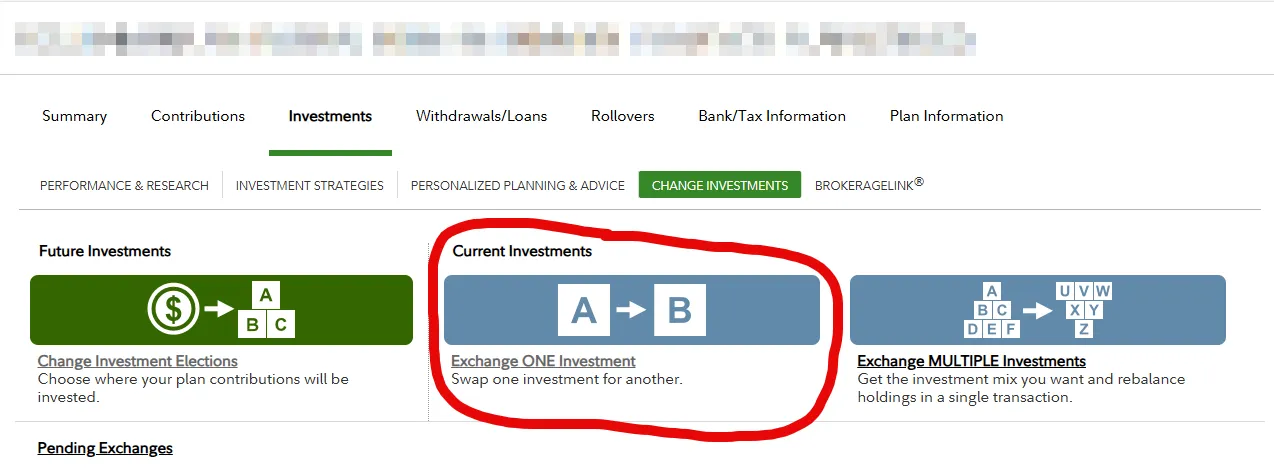
The move takes a day or two, and the money lands in BrokerageLink as cash. Set a reminder on your phone before you close the screen. When it lands, go back and buy your funds with it. Don’t let it fall through the cracks. Until you buy, BrokerageLink parks it in a money market fund. It earns a little interest, but it isn’t invested in your portfolio.
Moving your balance only covers the money you already have. Your next paycheck still goes wherever it went before.
On the same screen, choose Change Investment Elections. That’s where your future contributions get pointed.
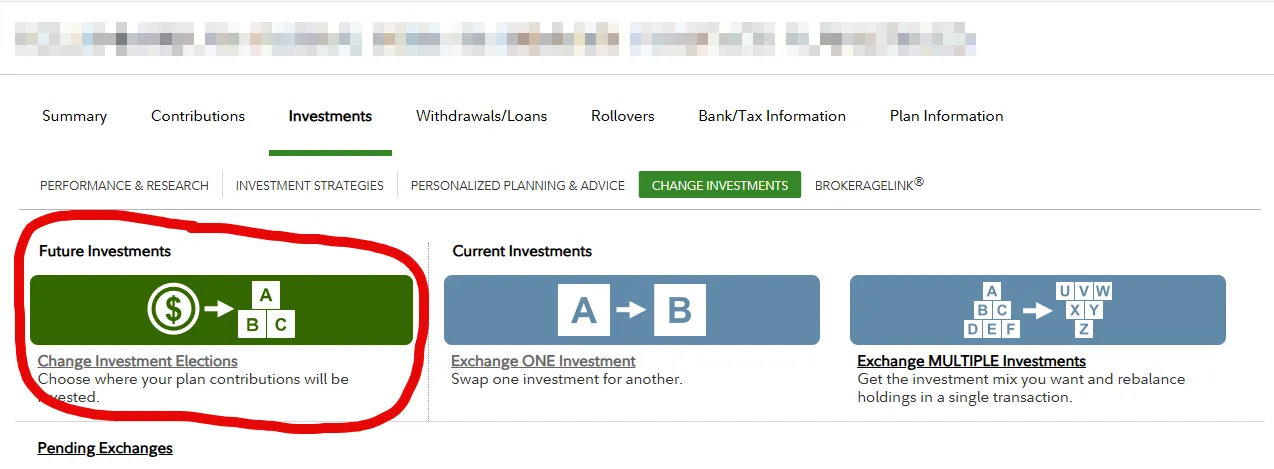
BrokerageLink is an option in that list, just like all the other funds. Give it the same percentage you moved in Step 1, and put the rest in your plan’s S&P 500 index fund. For my wife that’s 30% to BrokerageLink and 70% to the S&P 500 fund, so her old money and her new money hold the same thing.
Each paycheck, that percentage shows up in BrokerageLink as cash. Step 3 puts it to work.
Almost nobody does this step, and it’s the one that makes BrokerageLink work.
BrokerageLink shows up on Fidelity.com next to any other Fidelity account you have. You set up the automatic investment just like you would any other IRA or HSA. If you’ve followed my HSA automation steps, it’s the same screen. Fidelity’s 800 number will also walk you through it.
On Fidelity.com, open Accounts & Trade, then Transfers, then Manage recurring activity.
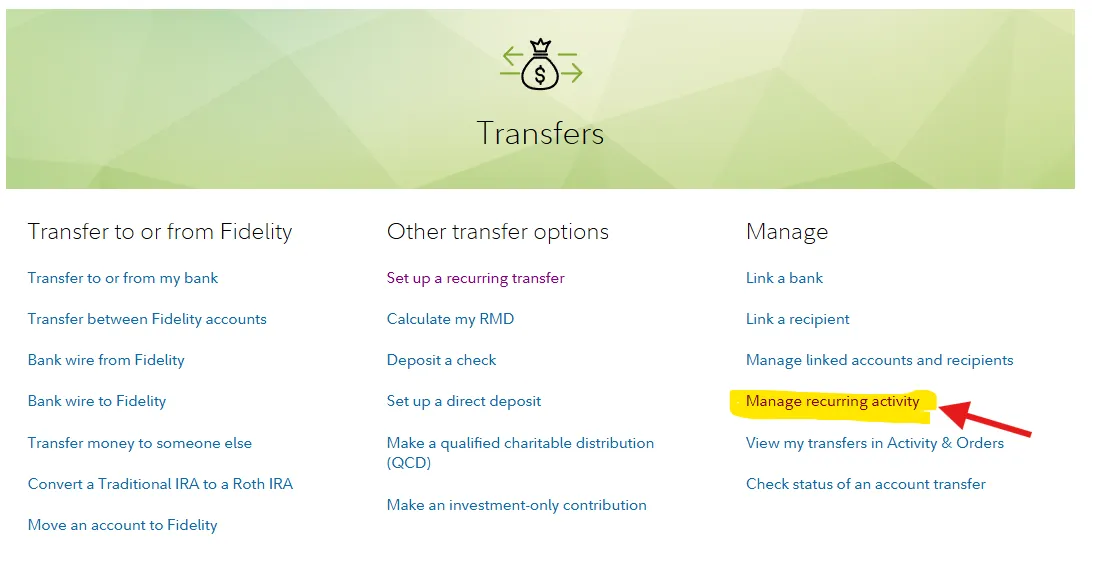
Choose Create new activity, then Investment.

Fill in the form:
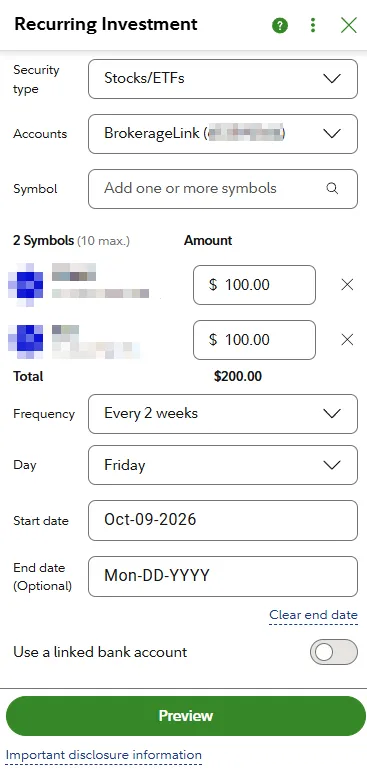
If your paycheck is the same every time, use exact dollars. Your contribution is a percentage, but the form asks for dollars. Say you save 10% of your salary and the share that lands in BrokerageLink comes to $127.32. Set your buys to add up to $127.32 and split that across your funds.
If your pay changes from paycheck to paycheck, here’s the trick I use for my wife. She doesn’t work the same hours every week, so what lands in her BrokerageLink is a little different each time. Instead of buying every two weeks, I have it buy every week. She’s paid every two weeks, so each weekly buy is a little less than half of what an average paycheck sends there. Each weekly buy tops off whatever cash is left over. The buy is split across her funds, so if one fund’s buy goes through and another has to wait for more cash, that’s fine. It’ll pick it up as it goes along.
Two things to keep an eye on. Rebalance once a year, and put it on your calendar. The end of September is a good date, the same one I use for the rest of the 401(k) in how to protect your 401(k) from a market crash. Uneven buys drift your funds away from the percentages you picked, and the yearly rebalance moves them back. And when you get a raise or change how much you save, update your automatic investment to match.
That’s the whole system. Payday comes, your contribution lands, your funds get bought, and you never log in to buy.
While you’re saving for retirement, only if you have a portfolio statistically tested to beat the S&P 500 over a long period, and your plan lets about 15% or more of your contributions go there. Otherwise your plan’s S&P 500 index fund is a good place to stay. If you’d pay for a portfolio service just for this account, you also want about $7,600 or more in BrokerageLink. Close to retirement, it’s worth it for an actively managed bond fund when inflation is clearly falling.
It depends on your plan. Some plans allow mutual funds only, some add ETFs, and some allow individual stocks, bonds and certificates of deposit as well. Margin and short selling aren’t allowed. Ask your plan when you call.
Yes, if your plan allows it. BrokerageLink shows up in your contribution elections like any other fund, and your plan sets how much of your contributions can go there. My wife’s plan allows 30%. Some allow 100%.
Yes. Set a recurring investment on Fidelity.com, under Accounts & Trade, Transfers, Manage recurring activity, with the security type set to Stocks/ETFs and your BrokerageLink account selected. It works the same way it does in a Fidelity IRA or HSA.
Buying stocks and ETFs online costs $0. Mutual funds outside Fidelity’s no-transaction-fee list cost up to $100 a purchase. Some plans charge an annual fee for BrokerageLink, so ask yours.
No. The money never leaves your 401(k). Pre-tax money stays pre-tax and Roth money stays Roth.
You do. Your employer’s plan committee picks and monitors the regular fund list. It doesn’t review what you buy inside BrokerageLink.
Want a tested portfolio to put in your BrokerageLink? That’s what I designed Gold+ for.
Gold+ connects your plan, portfolio, and protection in one system. See whether you’re behind, on track, or ahead, follow the Refined FI portfolio built for your stage, and get an email when market risk calls for a change.
Prefer to see it first? Watch the 2-minute look inside Gold+.
This article is for educational and informational purposes only and does not constitute investment advice, financial advice, tax advice, legal advice, or a recommendation to use any specific plan feature or investment. Refined FI is not a registered investment advisor. BrokerageLink rules, eligible investments, contribution limits, fees and minimums are set by each employer’s plan and can change; confirm yours with your plan. Portfolio returns shown through March 19, 2026 are backtested from the target allocations I used at the time and each fund’s adjusted closing prices, including reinvested dividends; from March 20, 2026 they use the portfolio’s recorded daily results. They are not an account statement, have not been audited, and exclude trade timing, uninvested cash, the gap between the buying and selling price, and taxes. S&P 500 returns use the SPDR S&P 500 ETF Trust. Returns through September 30, 2026. Past performance does not tell you what happens next. Fund costs are from each fund’s published expense ratio; BrokerageLink trading costs are from Fidelity’s BrokerageLink commission schedule. Screenshots are from a Fidelity NetBenefits and Fidelity.com account with personal details removed. Refined FI receives $0 in affiliate revenue, commissions, or compensation from Fidelity or any fund company mentioned here.
A little of everything is not a portfolio. Here is the 401(k) allocation by stage, and what belongs elsewhere.
19 min read
I used to sell 403(b) annuities to teachers, but not anymore. What I learned to do and what NOT to do could save you years off your retirement date.
20 min read

Two people can save the same money and end up with the same portfolio balance. One retires at 52. One has to wait until 59½. The only difference is which account the money went into.
23 min read